



02 Oct THE SUITCASE IN ALL ITS FORMS
THE LITTLE STORY OF AN OBJECT
THE SUITCASE
IN ALL ITS FORMS
A suitcase, who doesn’t have one? From the packs of the Romans to today’s connected suitcases, here is an everyday object full of history!
At the very beginning…
Since we travel, we pack our bags. In the Roman Empire, legionnaires packed their belongings in bundles.
For a long time, travelers were content to roll them up in saddlebags, wineskins, terracotta jugs, or roll them in a simple coat or even a sturdy sheet.
They strapped everything with a leather strap, which served as a handle… And presto, the suitcase was packed.
Design was not yet spoken of when the very first objects manufactured for travel were called trunks.
Those of the Phoenicians were made of rot-proof cedar wood, and in the Middle Ages, the trunk was even the main piece of furniture, serving as both a chair and a table…
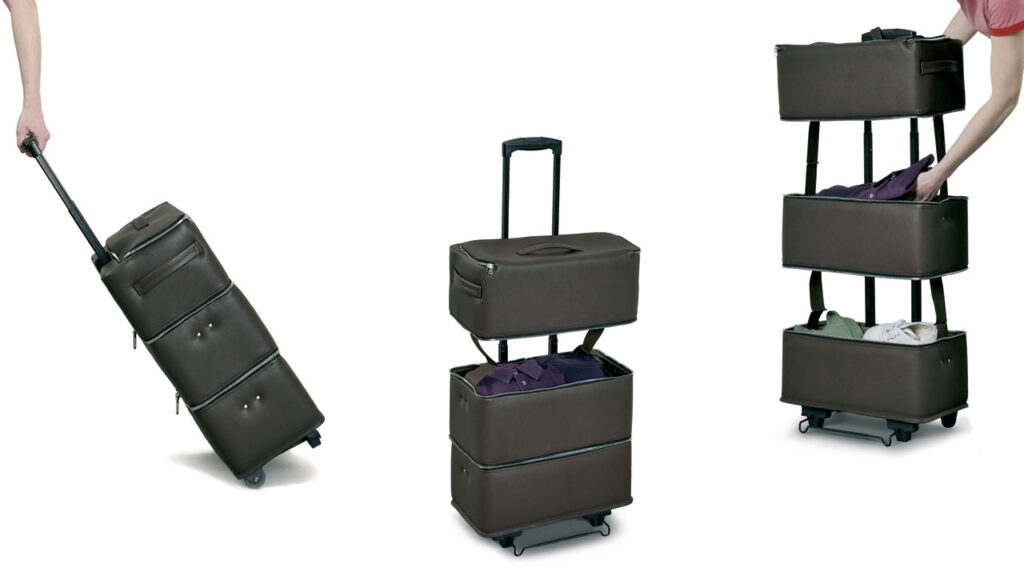
An idea taken up in 2007 by the designer Inga Sempé, who imagined a suitcase transforming into a storage unit once arrived at the destination.
But obviously, it was in the 19th century, with the appearance of steam propulsion, that the manufacture of luggage truly developed.
This was the golden age of the trunk. People then left it to others to place them on the roof of the stagecoach or in the cabin of the ocean liner for a journey that would last several days, often several months.
To see today some of these magnificent pieces from great luxury brands such as those of Louis Vuitton, Goyard, or Moynat… From these exceptional trunks like that of the former Tsar of Russia Nicholas Alexandrovich or that of Conan Doyle’s desk, one could, not long ago, go to the luggage museum in the city of Haguenau in Alsace, which possessed hundreds of them, and admire them as witnesses of this time when travel was reserved for an elite… This extraordinary collection created by luggage lovers, Marie and Jean-Philippe Rolland, is no longer exhibited in the museum since September 2025, and it is unknown if the new owner of these treasures will one day open a new place to exhibit them…
The Trunk
Today, the trunk has not really disappeared… Even if it is more of a luxury object than an everyday one.
But just because the trunk is not within everyone’s budget doesn’t mean we shouldn’t talk about it.
And why not dream about it! Otherwise, we would never talk about the paintings of Picasso, Van Gogh, or Renoir!
Just look at how wonderful those trunks are that are still being made at Goyard, the oldest leather goods manufacturer in France, created in 1792. And of course, also at Louis Vuitton, which produces several hundred of them each year on special orders.
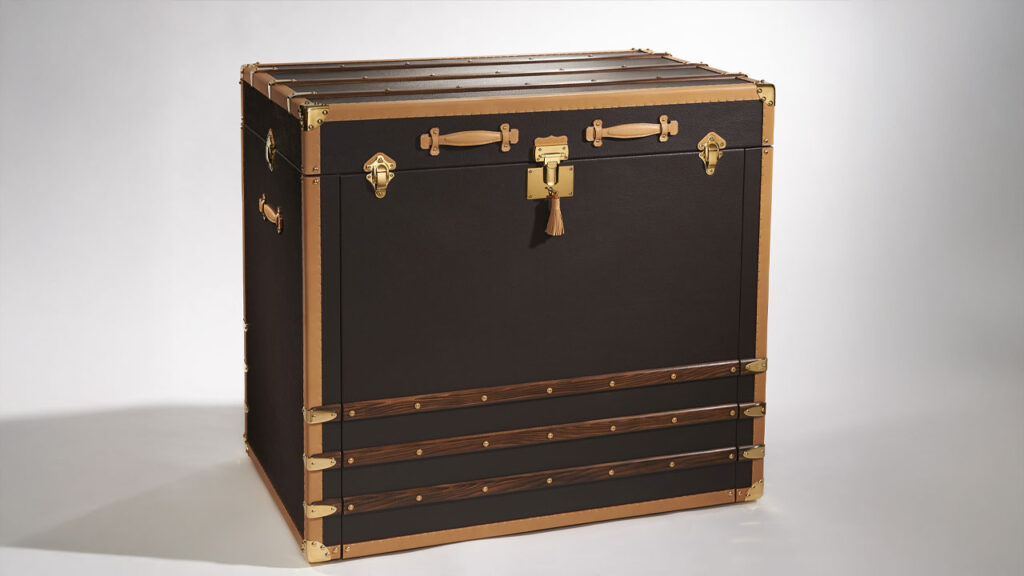
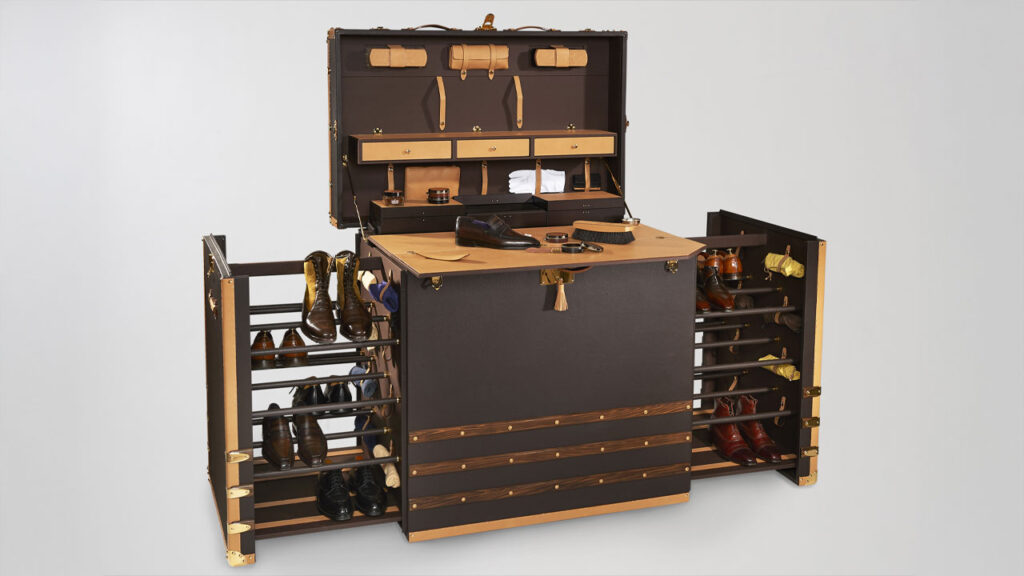
These objects from another time nevertheless continue to nourish both imagination and innovation, as at Master Craftsman Ephtée, where all sorts of trunks, unique and extraordinary, are invented.
Trunks with complications, small ones, large ones, suitcases, vanity cases, boxes, and briefcases.
« Magic boxes, » prefers to say Franck Tressens, who created this tiny company in 1998, whose name is phonetically that of the initials of his surname FT.
A « small » company that bears the label of Living Heritage Companies (EPV), celebrating the excellence of French know-how.
This state label, awarded for five years and issued under the authority of the Ministry of Economy and Finance, is aimed at all companies that hold excellent know-how combining tradition and innovation (institut-savoirfaire.fr/epv).
Even as a child, Franck Tressens had a real passion for boxes, and since he had no toys, he made them.
His first creation: a cardboard box with hinges where he hid his treasures… Since then, he makes people dream with his desk trunk or his bedroom trunk!
Or the chic picnic trunk ordered by Rolls Royce!
The Louis Vuitton family home
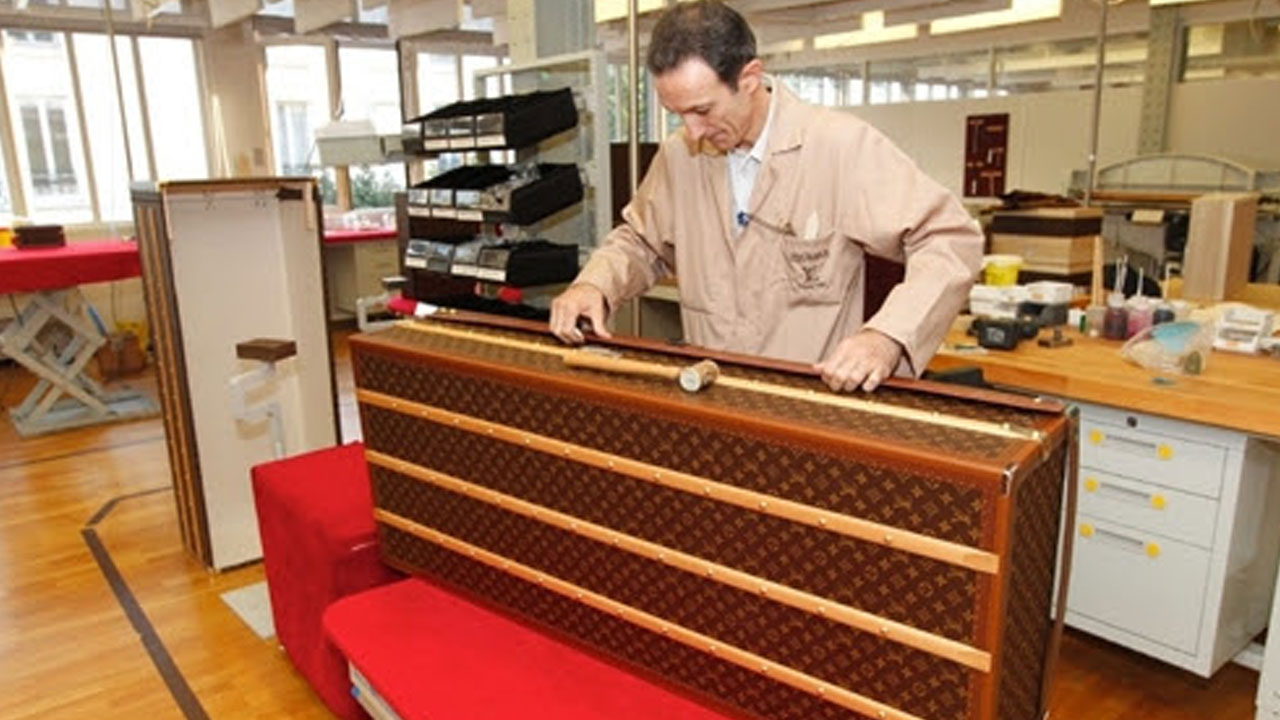
Located in Asnières, the Family Home houses both a workshop and a gallery to present the archives of the Louis Vuitton house. A true historical heart, the Asnières House was originally a workshop chosen for its location on the banks of the Seine in the northwest of Paris, which allowed efficient delivery of the raw materials needed to manufacture the trunks. Even today, the sounds of know-how punctuate this place of passion and exhibition. Inspired by the flat trunk created in 1858 by Louis Vuitton, the Malle Courrier was patented in 1867. The first version made of poplar barrel covered with Gris Trianon canvas is as light as it is waterproof. Its innovative shape, which allows easy handling, is perfectly suited to the era of the transport revolution. Its name, moreover, evokes the term « long haul » and the associated journeys by train or boat. The Malle Courrier embodies the essence of Louis Vuitton’s know-how: lozine, metal corners, rivets, lock, buckles, malletage, leather handles… so many codes to observe in the smallest details. As for the front of the trunk, it is equipped with two beech slats. Just imagining it, it’s crazy how much it gives us a traveling soul…
After the trunks, the first suitcases
As for the everyday person’s trunk, by the 1940s, it gradually disappeared, dethroned by the suitcase.
People traveled faster, in greater numbers, with each person responsible for managing their own luggage!
Hence the rise of the suitcase, a container that can be carried alone, slipped into the luggage compartment of a train or plane, or placed in the trunk of a car.
The first ones were often made of wood, but mostly of canvas or cardboard, like the famous cardboard suitcase of the Franco-Portuguese singer Linda de Souza.
Because for the emigrant leaving to try their luck far from home, the suitcase is the most precious possession.
So it must be both sturdy and light, flexible enough to adapt to its contents but rigid enough to protect them.
The suitcases we see in the luggage room of the Immigration Museum at Ellis Island in New York Bay or at the Immigration Museum in Paris, show us, beyond the history of these women and men who left their countries and cultures, that the history of the suitcase is also a question of material!
This is the observation made by Isaac Shwayder, a Polish emigrant to the United States.
He was a grocer and suddenly he wanted to manufacture resistant trunks and suitcases.
Oh, not for rich travelers! But for those who dream of becoming so by trying the adventure of the gold rush.
At the end of the 19th century, Jesse Shwayder, one of his eleven children, opened his wooden luggage shop in Denver, Colorado before founding the Shwayder Trunk Manufacturing Company with his brothers in 1910.
From the 1920s, the family business mass-produced hyper-solid suitcases.
So solid that they were then named Samson, in reference to the biblical hero… And that’s why the company took the name Samsonite from 1939.
Nevertheless, it was in 1937 that the suitcase got its real first facelift. And it was in Cologne, Germany.
A fire then destroyed the entire stock of the Rimowa luggage company, founded in 1898 by Paul Morszeck and Heinrich Görtz, originally called Görtz & Morszeck and having become under the aegis of Paul Morszeck and later his son, Richard, the brand « RIMOWA », registered at the Reich Patent Office in Berlin.
Barely having overcome the fire disaster, Richard Morszeck realized that everything had burned except the aluminum frames used for reinforcements, which had resisted the flames.
Eureka! From there, to imagine a suitcase made from cabin aluminum, there was only one step.
From then on, aluminum and grooves would be the famous trademark of the German firm.
Even if the ribbed aluminum used in 1937 is replaced today by polycarbonate.
In the 1950s-60s, innovations accelerated and followed one another.
The first soft suitcase made of nylon canvas and equipped with an outside pocket, saw the light of day in 1956 in the Parisian family business, founded in Paris by Angèle and Alphonse Lancel in 1876. It was called Kangourou.
Lancel is well worth a flashback.
So, back to the Belle Epoque. In the 10th arrondissement of Paris, precisely at number 20 Passage des Petites Écuries, the Lancel couple opened a shop selling pipes, smoking accessories, decorative items, artisan-made gifts, jewelry, porcelain, clocks, etc. Women were emancipating themselves and smoking! So they made the most chic cigarette case for ladies! And in the process, they invented a whole series of small leather goods in which these ladies would store their smoking necessities. The first Lancel bags were born. A few years later, at 17 Boulevard Poissonnière in the bustling district of music halls and theaters, all that Paris counted then of demi-mondaines, bourgeois women, cocottes, and stars rushed to buy the latest smoking necessity. The success was such that the house opened in the 1900s a good ten points of sale with exotic and evocative names: Au Sphinx, Au Phénix, A l’inénarrable, A l’indomptable… People fought over cigarette cases, clutches, alms purses, and handbags. To the point that the Lancel couple created a real leather goods workshop, and that Angèle had the idea of having a funny bag made with drawers hiding many secret pockets. Lancel soon opened boutiques in the provinces, but it was Albert (Angèle’s son) who transformed the family business into a real leather goods house, taking the reins from 1901. The handbag was then placed at the heart of the development strategy, and luxurious models in lizard, satin, or velvety calfskin became icons celebrated notably by Salvador Dali, Isabelle Adjani, and Brigitte Bardot.
From 1926, a luggage department was created, and the fine leather goods workshop invented the Aviona suitcase in 1928, then, in 1956, the Kangourou.
Remaining family property until 1997, the brand, which just celebrated its 150th anniversary in 2026, has since been bought by the Swiss luxury group Richemont.
The first major innovations
In 1965, the first molded suitcase was marketed by American Tourister.
The way was therefore open for modern hard luggage that could withstand being in the hold.
But the most spectacular innovation is, of course, the wheeled suitcase.
One might wonder why, 6000 years after the invention of the wheel, no one had thought of it before!
It seems so obvious! But they still had to be found, these materials that were both resistant and light, these mobile but solid axes, these joint systems, these fixed then flexible handles…
Who actually invented it? The paternity of the wheeled suitcase is still debated and perfectly illustrates the patent war in which luggage manufacturers then engaged.
It is said to be a certain Bernard Sadow who had the idea in 1970, after seeing an employee pushing a wheeled cart at an airport.
The Macy’s chain of New York stores would then have marketed it, but the American patent was broken by competitors.
What is truly known, however, is that the French brand Delsey bought the patent for the retractable wheel system and marketed the very first hard-shell wheeled suitcase in 1972, the Airstyle.
If the invention did not convince everyone at the time – starting with men, who did not find it very manly to pull a suitcase, and above all saw themselves deprived of a little of their power over women, who no longer needed their help to carry theirs – the wheeled suitcase ended up winning over all travelers, over almost the entire planet!
Becoming the symbol of the explosion of air transport and mass tourism and exasperating the inhabitants of Venice or Barcelona, who can no longer stand hearing these trolleys rolling day and night.
The suitcase of the future…
So today it remains to invent the suitcase that rolls without making noise… And why not the one that empties itself when you get back from vacation and puts your things in the washing machine… Imagining the suitcase of tomorrow, many designers have worked on it and are still working on it.
Like Inga Sempé and her shelf suitcase, a prototype produced in 2007 by the VIA, le French Design.
Or like Rodrigo Garcia Gonzalez, who designed a motorized and obedient suitcase;
It follows its owner thanks to the Bluetooth signal of their phone and could even climb stairs.
As for He Liangcai, a self-taught inventor, he combined a suitcase with an electric scooter to make luggage that transforms into a scooter, and vice versa.
The suitcase will therefore have been part of all the transformations of society and will never have been so much a part of our daily objects!
And the connected suitcase…
Obviously, as you might guess, the suitcase does not escape the connected world. Almost all brands have gotten into it.
A few examples. Delsey quickly entered the race. Not only did the French brand invent the variable size allowing travelers to respond to the dictates of airlines – We remove the wheels, and presto, the luggage goes from 55 cm to 50 cm… – But it also offers with its Pluggage line, the « plus plus » luggage, which allows you to travel truly high tech, for those who like it… An application geolocates your suitcase, locks it, unlocks it by fingerprint.
Not to mention the integrated scale with weight memory, the USB port to connect your device to your personal backup battery, the rubber port protection, etc. And also the weighing indicator – therefore of excess weight.
How far will the suitcase go? The future will tell us. But it certainly hasn’t had its last word.
And have you heard of the G-RO UFO by Ken Hertz and Netta Shalgi, respectively a lawyer in Los Angeles and a designer in Tel Aviv!
What is the suitcase UFO in question made of? Polymer wheels as wide as the bag, a two-USB charging station, with an exterior laptop pocket and a tablet to rest it on, a TSA lock, a protected space of waterproof ballistic Nylon, as well as an extra-long handle.
As for Jan Roosen and Stefan Holwe, they launched Tote, a Berlin label that presents an entirely contemporary collection with the most advanced equipment: smooth and robust trolley, all-terrain, wide and silent wheels, 360° steerable, a travel assistant in the form of a smart card linked to the smartphone (Android or Apple), which warns its owner of a distance beyond 30m and a built-in battery allows various devices to be recharged.
As for Lancel, if the Kangourou, which has become a vintage object, is sold in auction rooms, the brand, which has reopened its historic boutique in the Parisian Opera district, then skips the stages of modernity faster than the animal… You can’t stop progress!
Here it is indeed making its entry into high tech with the Explorer, adorned with zip pullers and snap fasteners, ballistic Nylon and a leather version, and equipped with the E-lostbag system, a secure geolocatable beacon equipped with an RFID chip.
And what about ecology in all this?
The suitcase will therefore have offered us everything, from solid, flexible, waterproof, useful, beautiful, creative, design, chic, very chic, high tech, etc. But what about ecology in all this?
Because, do you know: of the 400 million models of suitcases sold worldwide, 84% of damaged ones are thrown away!
Yes! Because come to think of it, who hasn’t thrown theirs away because the wheel broke, the handle gave way, etc.?
We have not verified these staggering figures. They are put forward by Julien Ehret, who took over l’Alsacienne de maroquinerie, a company founded by his great-uncle in 1961 in Molshein.
To move towards virtuous eco-sustainability, he first tried to develop a rental system, a project that remained in the drawers as people don’t really like to share the suitcase object.
To each their own! Then he went back to the drawing board and imagined an eco-designed suitcase that is infinitely repairable.
With his Dot-Drops concept, the suitcase is hyper solid, four times more solid than a classic model, according to Julien Ehret and everything runs smoothly!
Because it is 95% repairable. Upon purchasing a suitcase, you receive its health record, in a way.
In case of a glitch, the brand – whose suitcases are inspired by the airport flooring imagined by Julien’s father – sends you the spare parts free of charge for a period of twenty years.
It’s up to you to handle the repair using a video tutorial.
If the problem turns out to be more serious, the firm’s workshop takes charge of the luggage.
And takes care of recovering it to recycle it at the very end of its life.
But that’s not for tomorrow because the adventure only started in 2022.
Especially since there is nothing to complain about regarding the design and beauty of this brand new eco-sustainable suitcase.
In the beautiful range of colors offered – orange, blue, bronze, yellow, red – the classic wins the prize when it comes to recycling: it is produced from the scraps resulting from the manufacture of the other shells.
And when it is finally possible to find an industrial partner who can carry out both plastics processing and leather goods in small quantities, the shells and the sewing of the zipper will no longer be done in China.
Travelers will then be able to resolutely go green, with the satisfaction of being a little more virtuous!
When the suitcase inspires creators and becomes a fashion accessory or contemporary artwork?
There, obviously, the editions are more than limited. But they are worth admiring.
Kim Jones, artistic director of Dior’s menswear collections from 2028 to January 2025, and Virgil Abloh, director of menswear at Louis Vuitton, have tried their hand at it.
The first with luggage from the Rimowa house decorated with the « Oblique » motif that takes up the Dior letters on a cabin suitcase.
The second, son of Ghanaian immigrants, an architect by training, a graduate in architecture from the Illinois Institute of Technology and in civil engineering from the University of Wisconsin at Madison is a multidisciplinary creator considered the only designer capable of reconciling luxury and the street… And he imagined for Off-White, the brand he created in 2013 in Milan, a model in translucent polycarbonate.
It’s certain that if you pull this trolley in any airport in the world, you are not likely to go unnoticed!
Another idea of transparency: in 2019, still for Rimowa, Californian artist Alex Israel, painted the shell of his suitcase with color gradients imitating the shades of the L.A. sunset. Even if it was presented at the Frieze Contemporary Art Fair in L.A., the artist does not consider this suitcase as art but as a collaborative everyday object.
And when it comes to suitcases, you haven’t seen anything if you haven’t seen the American Rick Owens when he decides to make his own cabin suitcase for the Rimowa brand and presents it on January 23, on the runway of his Fall-Winter 2025-2026 show, whose entire theme revolves precisely around travel.
Because it’s really worth the detour. He who declares he always wanted to be a legendary eccentric, a major weirdo, then chooses the major alliance of leather and bronze.
Leather inside to imitate the feel of a glove, the luggage tag in hairy cowhide, discreet logo, aluminum, and bronze finishes to recall works by Serra or Brancusi.
There, the « eccentric » gives us a glimpse of his taste for quality and design as he had done for the furniture of Karl Lagerfeld’s former private mansion.
How far will the suitcase go?
In any case, it never ceases to inspire creators. American rapper Tyler, The Creator, who found himself a tailor-made stage name allowing him to play all the strings he has to his bow – American music producer, actor, designer, graphic designer, director, screenwriter, stylist, and artistic director – has also signed a suitcase that he baptized « International ».
Under the name of the brand he created, Golf Le Fleur and with the complicity and excellence of French know-how of Master Craftsman Franck Tressens and his house Ephtée.
We don’t know if the rapper came with it to the Parisian concert he gave at the Accor Arena in the spring of 2025;
but if you saw a pastel pink suitcase circulating on the baggage carousel at Roissy airport, with beautiful manners and materials, wood, leather, and microfiber, leather corners, solid 24 ct gold brass corners, it was certainly his.
© Alain-Caboche
© Alain-Caboche
Désolé, le formulaire de commentaire est fermé pour le moment.