



14 Jun The Thousand and One Lives of the carpet
BEAUTIFUL EVERYDAY OBJECTS
THE THOUSAND AND ONE LIVES OF THE CARPET
A rug—who doesn’t have one? You’d think design has always existed!

Human beings have indeed always seemed to seek, according to their time and culture, to build their dwellings in the best possible way, making them more, more, more… More comfortable, more welcoming, more practical, more ingenious. And more beautiful! Yes! Because a rug—who doesn’t have one? Let’s not forget that the beautiful Cleopatra is said to have presented herself to Caesar wrapped in an Oriental rug! Even my grandmother, who lived in a rammed-earth house in Brittany, had one! And this is nothing new. Far away from us, an Iranian proverb states: “The house is where the rug is spread.”
As old as humanity’s first garments, as utilitarian as it is sacred, the rug is Persian, Afghan, Pakistani, Baluchi, Turkmen… as well as Armenian, Indian, Tibetan, Turkish, and Chinese. It comes from the Caucasus, from Eastern Turkestan, from Europe and North Africa.
It is present in all the nomadic tribes of the Silk Road. Rugs were then made of sheep’s wool, more rarely of silk, while cotton and hemp were used to create the warp and weft. They served all kinds of functions: at once curtain, floor covering, mattress, blanket, tablecloth, bag, and partition.
The art of knotting rugs is thought to have developed in the steppes of Central Asia, when nomadic peoples, needing to protect themselves from the intense cold of winter, made rugs to line their yurts and tents and cover their floors. Or they sold them in markets. They were made from the wool of their herds, and their colours came from the plants found locally. The looms, made of two pieces of wood over which the warp was stretched, were easy to transport.
According to some archaeologists, the art of weaving may date back to the very beginning of sheep domestication, 8,000 years before our era, with the first looms appearing in the Neolithic period!
Come, let’s go on a journey to discover the rug, this millennia-old design object!
SUMMARY
- Episode 1 – The Star Rugs
- Episode 2 – When Carpets Leave the Land of Nomads
- Episode 3 – From the 1920s onward, carpets regain their prestige – the Bauhaus women and Eileen Gray
- Episode 4 – Silence, We’re Weaving at the Gobelins Manufactory
- Episode 5 – The Carpet: Still in Vogue with Pierre Paulin, Elisabeth Garouste and Bonetti
- Episode 4/1 – Silence, We’re Weaving. At the Chichaoua Cooperative in Morocco and in the Dyeing Workshops of France
- Episode 5/1 – The Carpet, Still Going Strong, with Inspiring Designers – the Bouroullec Brothers, François Mangeol and Many Others…
- Episode 4/2 – Silence, Weaving at the Moroges Manufactory in Burgundy
- Episode 6 – Some News
- Episode 7 – Carpet News in High Places
- Episode 4/3 – Silence, Weaving at the Tai Ping Carpets and Cogolin Manufactories
- Episode 8 – Stunning Carpets, Contemporary Textures and Innovation
Episode 1
THE STAR CARPET
THE PAZYRYK CARPET
Imagine this! It is 1950, and it is announced by Sovinformburo that two Soviet archaeologists, Rudenko and Giazno, made a stunning discovery the previous year: during excavations in the Altai Mountains, and more precisely in the Pazyryk Valley, they uncovered the oldest knotted rug in the world. It is said to date back to the 5th century BC, making it more than 2,500 years old!
Even today, at the Hermitage Museum in Saint Petersburg, researchers are still trying to decipher its history and the stories it tells… Because beyond their function, rugs speak. In geometric or non-geometric forms are written the signs of the sky and nature, as well as daily activities and concerns. This remains true in the 21st century, with rugs decorated with bombs and helicopters, woven by Baluchi nomadic women fleeing Afghanistan. Or with the “war rug” created by Afghan artist Hadi Rahnaward using tens of thousands of matches… ready to ignite, a terrifying metaphor for the conflicts that force populations into exile or suffering. This work was shown at the Palais de Tokyo in 2024 in the exhibition Dislocations, which brought together 15 exiled artists.
But let us return to this Pazyryk rug. It adorned the tomb of a Scythian chief, this warrior people who, from the 8th century BC onward, travelled across the steppes on horseback… It fully deserves the title of the rug’s “Hibernatus”, since it is indeed thanks to Lady Freezing that it has survived to us today, after having remained sealed for centuries, trapped in a block of ice during a terrible glaciation.
With its 360,000 knots, it is astonishing in its quality, density, design, and colours. It measures no less than 2 metres in length and 1.83 metres in width. Look closely at its motifs: they trace the wandering journey of the steppe horseman.
Hermitage Museum, on the banks of the Neva, Saint Petersburg.
hermitagemuseum.org
THE ARDABIL CARPET
Let us leave Saint Petersburg for London. To greet another star carpet. In reality, there are two. Both were commissioned by Shah Tahmasp for the Sheikh Safi mosque in the city of Ardabil in Iran, 400 km from Tehran.
Made in the year 846 according to the Muslim calendar, that is 1539 of our era, they are said to have required the steady work of five weavers for more than three years. But, after an earthquake in 1873 that destroyed a large part of the mausoleum, the carpets were sold to a Manchester company in order to finance the restoration of the mosque.
It is then that one of the carpets was used to repair the other. The restored carpet can be seen at the V&A Museum in London and the fragments of the second are at the museum in Los Angeles.
KILIMS
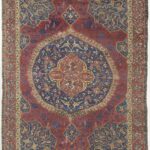
Leaving Istanbul’s Grand Bazaar and heading towards Konya in central Anatolia, we arrive in the land of kilims. And once again, one wonders whether weaving might be the oldest human artistic production—the first form of writing.
Here, one can almost still hear what the great Sufi mystic Djal al-Din Rumi said:
“In the rhythms of weaving lies a secret, and if I revealed it, it would shake the world.”
For Elisabeth Wayland Barber, American archaeologist and textile expert, born in 1940 in California:
“Weaving is one of the earliest human technologies, often overlooked, but fundamentally linked to survival and the creation of social bonds. Women of the Paleolithic period, through their hands and expertise, literally shaped the fabric of life.”
Elizabeth Wayland Barber, Women’s Work: The First 20,000 Years. The origin of weaving may take us back to the Neolithic era (10,200–2000 BC), when humans began interlacing grass, stems, and tree branches to create baskets and shelters. This was the primitive form of weaving.
Elisabeth Wayland Barber, for her part, dates the first domestication of fibres to the first representation of a loom on an ancient Egyptian pottery piece from 4400 BC.
Textiles have also been found at Çatal Höyük, an archaeological site in Anatolia, in the Konya plain, on the banks of the Çarşamba River, which testify to the existence of plain-weave textiles dating back to around 7000 BC. And it is precisely in the Konya region that a British archaeologist, James Melaart, discovering in the 1960s frescoes showing striking similarities with kilims, concluded that this weaving art could date back to the beginning of sheep domestication… 8,000 years before our era! Experts are still debating this… but ancient kilims are sold for a high price.
The earliest kilims found date back to the 13th century. Mainly woven (the word kilim means “woven”) for domestic use by women of nomadic tribes, they sometimes served as a bride’s dowry. In France, the popularity of kilims is due to Henri Daumas, who discovered them during a trip to Lebanon and never stopped travelling through Turkey, a major kilim-producing country, to bring back sublime pieces. In 1972, he opened with his wife Jacqueline a space in Paris, the Triff gallery, where they were exhibited for the first time in the city. Taken over in 2007 by their son Éric and his wife Nathalie, at 13 boulevard Raspail in Paris’s 7th arrondissement, it was long dedicated to showcasing the colour and material of this millennia-old “object”, before closing its doors… while continuing to carry the passion for kilims through the website https://www.triff.com and on Instagram.
THE MARBY CARPET
The journey of the carpet now takes us to northern Europe. We are in Stockholm, at the Historical Museum. Of course, it is not in the most visited sections, those devoted to gold and the Vikings, that we are heading. No! But into the rooms dedicated to textiles. Here, you can admire a true jewel, a witness to the West’s passionate love for the East—even in Sweden! The Marby carpet.
Hand-knotted in the 15th century in the Anatolian plains of Turkey, it was discovered in 1925, in two pieces, in the abandoned church of a small village called Marby, in the province of Jämtland. How did it end up there, in an abandoned church? A mystery! As mysterious as its arrival in Sweden… It is said to have entered the ducal house of Holstein-Gottorp as part of the trousseau of the future Queen Hedwig Eleonora, before her marriage in 1654 to Charles X Gustav. Lucky Hedwig!
It most likely belongs to the family of animal-themed carpets, made according to the tradition of the early Ottoman period in Anatolia, depicting, within an ivory-coloured octagon, stylised red birds among tree-like forms.
https://historiska.se/en/explore-history/history-hub/the-mysterious-carpet/
THE MANTES CARPET
And now, after the fabulous adventures of the Pazyryk carpet, the Ardabil carpets and the kilims, here is the no less fabulous and strange story of the Persian carpet of Mantes.
Dating from the 16th century, it was discovered around 1910 in the chapel of the Collegiate Church of Mantes. Yes, Mantes in the Paris region. But it was found in a very poor state. It is said to have served as a draft stopper, or even a floor cloth, during renovation works in the chapel.
But how did it get from Persia to Mantes? Several hypotheses exist. Perhaps through one of the French embassies in Persia? Perhaps it belonged to the Duchess of Berry, who donated many carpets to this town in the Yvelines department. In any case, this affair caused quite a stir in the major circles of the time.
Today, this carpet, with a central star-shaped medallion depicting a battle scene with phoenix and dragon surrounded by four panthers, rests peacefully in the Islamic Art department of the Louvre.
https://www.louvre.fr/recherche-et-conservation/departement-des-arts-de-l-islam
THE ABU DHABI CARPET
Our journey through the world of star carpets began with the oldest in the world. It ends in the United Arab Emirates, with the largest carpet ever created, designed by the Iranian artist Ali Khaliqi for the Abu Dhabi mosque.
47 tonnes, 5,700 square metres, as large as an American football field, and 1,200 craftsmen. Including many Iranian women weavers and more than 50 workers. Nothing less. To weave 2.2 billion knots using 25 colours, derived from natural dyes and 38 tonnes of wool and cotton.
THE IRANIAN CARPETS
But oops, this journey—however incomplete—would commit a serious mistake if it did not pass through the city of Isfahan (Isfahan, in Arabic), in Iran. A masterpiece of architecture, the city is undoubtedly one of the most refined in the entire Islamic world, and very likely the cradle and the Rolls Royce of carpets.
Entering the workshops of the city, where carpets of worldwide reputation are still made, is to taste the delights of the East as the painter Delacroix admired them. He wrote in his journal: “The most beautiful paintings I have ever seen are certain Persian carpets.”

Episode 2
WHEN CARPETS LEAVE THE LAND OF NOMADS
They go on to adorn the palaces of the great lords of the East. Woven with silk and velvet, sometimes enhanced with gold thread, offered to diplomats or brought back by knights returning from the Crusades, they amaze the West. From the end of the Middle Ages onward, Venetian and Genoese merchants indeed turned them into a major trade, and Oriental carpets became a sensation across Europe. They were the height of refinement! They even appear as stars in paintings by Venetian and Flemish artists. But too precious to be placed on the floor and walked on, they long covered furniture and walls in grand houses before becoming “floor carpets.”
In France, the Court and the nobility acquired them at great expense. This was due to the lack of local artists and craftsmen able to compete with the velvety quality of Levantine works. Such pharaonic spending was something Henri IV, Louis XIII and Jean-Baptiste Colbert would have liked to put an end to. This was achieved in 1627 with the creation of the first manufactory…
Until the 19th century, Oriental carpets continued to inspire dreams, but demand kept growing and production struggled to keep up. The Industrial Revolution therefore came at just the right moment. After many developments in weaving looms, the real breakthrough came from a man from Lyon, Joseph-Marie Jacquard, who gave his name to the loom he invented in 1801.
While it helped democratise carpets, his invention also drastically reduced labour needs and led, in 1831, to the famous revolt of the Canuts, the silk workers of Lyon.
At the same time, synthetic dyes were also introduced to speed up the dyeing process. This made production cheaper, but the colours lost their brilliance, and the carpet lost some of its appeal.
Episode 3
From the 1920s onward, carpets regain their prestige – the Bauhaus women and Eileen Gray

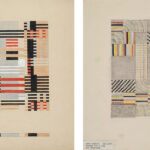
In the aftermath of the First World War, there is a desire for something new, to finally move beyond the 19th century. From being a simple decorative, bourgeois element, the carpet becomes a major work in its own right. In particular with Eileen Gray, a major figure of Art Deco, and in Germany with the avant-garde movement of the Bauhaus and its women artists and weavers such as Anni Albers and Otti Berger.

Anni Albers and Otti Berger
How could we talk about contemporary carpets without mentioning the artist-craftspeople of the Bauhaus, this interdisciplinary artistic and social movement created by the German designer Walter Gropius in the aftermath of the First World War.
To expand its studio, he invited designer-artists to create textiles and even opened weaving workshops in Weimar, Dessau, Bernau, and later Berlin. Here, the Bauhaus spirit is fully applied: teaching, learning, and producing by hand… The artist is therefore also a craftsman. They stand at the loom, confront material and technical challenges, and create while making. Thus, between the 1920s and 1930s, an entire generation of artists became passionate about carpets. These were often women: Anni Albers, Benita Koch-Otte, Margaretha Reichardt, Gunta Stölzl, and Otti Berger. They were called the “Bauhaus girls.” It should be noted that women artists were systematically directed toward the weaving workshop (sic!).
Anni Albers combined traditional and industrial materials, mixing paper, cellophane, and jute to achieve new effects, and pushed her research as far as creating a carpet that reflects light and absorbs sound. A pioneer. Fleeing Nazism, she went into exile in the United States in 1933. She was one of the few women of the Bauhaus school to achieve fame during her lifetime, and her work was notably exhibited in 1949 at New York’s MoMA.
As for Otti Berger, when she left the Bauhaus in 1932 to found her own textile research studio, shortly before the movement itself was closed by the Nazis, she could not yet know that she would soon be banned from working and deported to Auschwitz, where she was murdered.
Closer to our time, designers such as Eileen Gray, or artists like Picasso, Miró, Sonia Delaunay, and Bacon, would appropriate the creative space of the carpet—especially since Bacon had worked as a designer and decorator before becoming the painter we know today.
Eileen Gray
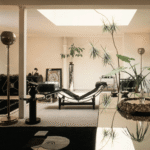
If we now slip into the storage rooms of the Musée des Arts Décoratifs in Paris, and try to find out what lies behind inventory number 41971, you will have guessed it: it is a carpet! A creation by Eileen Gray, one of her best known, the Mediterranean Carpet. Alongside the De Stijl model, a handwoven wool piece from New Zealand, it features, on an off-white background, a beige circle, perpendicular lines in black strokes, and a navy blue square.
This architect and designer, who fled her aristocratic Irish family to settle in Paris, where she would live until her death in 1976, was rediscovered in the late 1970s by Yves Saint Laurent and Andrée Putman, another great figure of design, to whom we owe the iconic black-and-white check escalators of the Bon Marché department store in Paris. It is therefore no coincidence that several of Eileen Gray’s carpets are reissued by Ecart International, Andrée Putman’s publishing house for furniture and design.
With Eileen Gray, the carpet—having faded into the background after the 19th-century textile revolution—re-emerges in a resolutely abstract form. It all began in 1908, during a stay in the Moroccan Atlas Mountains with her childhood friend Evelyn Wyld. There, she learned to dye and weave wool. Alongside lacquer work, textiles became another of her passions, leading her to open a weaving workshop at 17 rue de Visconti in Paris’s 6th arrondissement. Between the 1920s and 1930s, she designed a series of carpets exhibited at the Jean Désert gallery, which she opened with the help of her friend, the architect Jean Badovici.
Of course, the boom in wall-to-wall carpeting in the 1950s changed everything and pushed rugs into relative obscurity. Only the hippies of the 1970s managed to save them, as they were fond of Greek shaggy rugs known as flokatis, and brought kilims back from the Kathmandu markets, sold by the kilo. Once considered outdated, the carpet regained ground. Carpeting out? Almost. Because the carpet has a powerful ally: health! Dust mites and allergies caused by wall-to-wall carpets helped carpets return to covering floors once again—and allowed artists and designers to invent a new era for them. And you will see, it is astonishing how much they inspire them!
Episode 4
SILENCE, WE’RE WEAVING AT THE GOBELINS MANUFACTORY
But let us go back to ancient times, when Oriental carpets made Europe dream and caused royal courts—especially the French court—to spend enormous sums of money. But how could these lavish expenses on carpets, so necessary to the sovereign and the court, be reduced?
Henri IV, the “good king” who ended decades of religious division and to whom the famous phrase “Paris is well worth a mass” is attributed, had a brilliant idea: to have these marvels produced in France. In 1601, he established workshops in Paris, in the Faubourg Saint-Marceau (today Saint-Marcel), where two Flemish weavers, Marc de Comans and François de La Planche, took charge. There, since the 15th century, a certain Jehan Gobelin, a wool dyer renowned for his scarlet reds, had rented a mill near the Bièvre river, known as the Gobelins Mill, named after the family of dyers who had worked there for generations. Then, in 1606, the same Henri IV created workshops for artists and craftsmen making carpets “in the manner of Persia and the Levant” in the galleries of the Louvre.
Later, his son Louis XIII continued his father’s work by establishing workshops on the banks of the Seine at the foot of the Chaillot hill, in the buildings of a former soap factory—hence the name Savonnerie (“soap factory”) later given to the workshops in Paris and Lodève, which since then has referred to carpets made using the knotted-pile technique known as the “Turkish” style.
Finally, it was done: in 1662, the Paris workshops became property of the Crown, and some were grouped together by a decision of Jean-Baptiste Colbert into a single site, the Manufacture des Gobelins. Its first director, the official painter of the Sun King, Charles Le Brun, employed a whole generation of painters, tapestry weavers, as well as founders, goldsmiths, cabinetmakers, and metalworkers. This marked the peak of the great wall hangings.
Among them is the famous Story of Moses tapestry series, woven around 1685 on the high-warp looms of the Gobelins, where the workshop painters translated the designs by adapting eight paintings by Nicolas Poussin and two by Charles Le Brun. It belongs to the collections of the Mobilier National.
In 1663, Colbert also reorganised the Savonnerie workshops, still under the direction of Charles Le Brun. Specialised in velvet pile carpets, they have been attached since 1826 to the Gobelins site and also maintain a branch in Lodève. As for the Manufacture de Beauvais, which produces low-warp tapestries on horizontal looms, it was created by Louis XIV in 1664, strategically located on the road to Flanders to block imports of Flemish goods.
Since 2025, the three national manufactories—the Gobelins, Beauvais, and the Savonnerie—have been brought together within a public institution called the Mobilier National, which also brings together several other flagship institutions of French excellence in crafts, design, and decorative arts.
The royal manufactory of Manufacture d’Aubusson
Founded in 1751 in the department of Creuse and now known as the Cité internationale de la tapisserie, it produces many high-end carpets and rugs for luxury hotels, as well as for the rail and maritime sectors and for institutions.
Already listed in the French Inventory of Intangible Cultural Heritage, Aubusson tapestry has recently received another laurel: in 2021, its weavers in turn were added to the Inventory—or rather, their know-how was!
The site is thus overflowing with distinctions. It was already inscribed on the UNESCO Representative List of the Intangible Cultural Heritage of Humanity, and had been awarded the EPV label (Living Heritage Company). That is not all. It has, for several years now, been protected by another label that serves as a strong safeguard against counterfeiting: the PGI, or Protected Geographical Indication. Because excellence is expensive, and at around €6,000 per square metre, it inspires many unscrupulous imitators!
At the Manufacture des Gobelins, copies of these Oriental carpets that once inspired painters and writers such as Delacroix, Holbein, Lotto, Chateaubriand, Oscar Wilde, Edgar Allan Poe, and even Freud—who had them everywhere, including on his famous couch—are still sometimes woven.
But today, in the two workshops of the Gobelins manufactory, in Paris and Lodève, work is mainly based on designs by contemporary creators such as Matali Crasset, Frédéric Ruyant, Sam Baron, and many other designers.
Matali Crasset: her carpet Hommage to Ledoux’s utopia and her Roots carpet
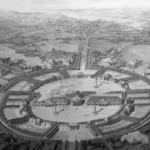
What stories lie beneath these carpets? By the way, it was precisely at the Gobelins manufactory that the carpet Hommage à l’utopie de Ledoux was woven. A way for Matali Crasset to bring utopia to our feet—or to suggest that utopia has always been under our feet. Still possible? This is the utopia dreamed of by Claude-Nicolas Ledoux, one of the first thinkers of architectural utopia, to whom she pays tribute.
Architectural utopia was first developed by the great Enlightenment architect in Arc-et-Senans. In this town in the Jura, one can still find the Royal Saltworks, an industrial facility for extracting rock salt from Franche-Comté, created under Louis XV, which he designed, along with his utopian city arranged around the factory. Ledoux dreamed of building a better world and imagined buildings where people could move freely, meet, learn, enjoy themselves, and laugh… He had planned everything: schools, hospitals, town halls, agoras, and more. He called it “the ideal city of Chaux.” Ideal, and capable of making people happier. He devoted thirty years of his life to it, from 1773 until his death in 1806. But this architecture meant to make people happier remained unfinished! Not so Matali Crasset’s carpet!
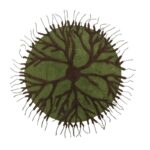
No less so for another carpet, produced for the Italian publisher Nodus, in wool and handwoven by four weavers in Nepal over three months. The French designer, who likes to describe herself as a designheureuse, chose to call it Roots. Here too we remain in the realm of utopia, but with it, having a tree in your living room is no longer a dream.
Episode 5
The Carpet: Still in Vogue with Pierre Paulin, Elisabeth Garouste and Bonetti
In the 1970s, hippies brought carpets back into fashion, and designers such as Elisabeth Garouste and Mattia Bonetti gladly took advantage of this revival in the 1980s. But for Pierre Paulin, it was an older love story. The French designer adored the tatami. Fascinated by traditional Japanese housing, he began, as early as the 1950s, to imagine a carpet on which one could sit. He drew up plans for it in 1968 for the American publisher Herman Miller. It was never produced. No matter! He made it himself for his house on Rue des Ursulines in Paris. Then, at the end of the 1970s, his carpet-seat climbed onto the wall, curved at the corners, and hovered somewhere between a flying carpet and a tatami. It was made of wool, wood, and PVC. It consisted of a PVC-coated canvas sheet, four corner supports in plywood and laminate, and a wool carpet!
As for Elisabeth Garouste and Mattia Bonetti, decorators, designers, and artists, they were riding a wave of success at the beginning of the 1980s, especially after creating the interiors of Le Privilège, the restaurant of the famous nightclub Le Palace. Leading figures of a movement that revived the tradition of the decorative arts by combining craftsmanship and design, they achieved great success by creating contemporary-patterned carpets for Habitat—the first champion of the idea that the useful can be beautiful and the beautiful can be accessible, according to the philosophy of its British founder Terence Conran. In doing so, they reconnected with the ornamental tradition of the decorative arts. At the same time, they moved away both from Oriental styles—which were then dominant on the market—and from the functional, minimalist aesthetic of the time. They were even called the “New Barbarians”, after the gallery En attendant les Barbares, at 35 Rue de Grenelle in Paris, created by Agnès Kentish, a collector of art furniture, and Frédéric de Luca, who published their work.
Later, in 1993, they created, again for Habitat but with another publisher, Sam Laïk, a carpet called Tapis Rêverie, made of hand-tufted and hand-carved wool on a canvas backing. Then, before separating in 2000, the two designers designed a velvet carpet called Diabolo, produced at the Savonnerie manufactory and now part of the collection of the Mobilier National.
From then on, the carpet became a playground for designers. And because today people enjoy sitting on the floor and have developed a passion for decoration and design, the carpet has definitively stepped out of its bourgeois frame.

Episode 4/1
Silence, We’re Weaving. At the Chichaoua Cooperative in Morocco and in the Dyeing Workshops of France
Halfway between Marrakech and Agadir, the Chichaoua Weavers’ Cooperative perpetuates the age-old art of Berber weaving, creating carpets with complex geometric patterns that tell the stories of Amazigh tribes. This women’s cooperative illustrates the excellence of traditional weaving while contributing to the economic empowerment of rural women. Nearly 200 rural women work here. This activity provides them with a regular source of income, helps preserve their traditional way of life, and enables the transmission of Berber weaving skills to younger generations.
Using traditional looms, they create carpets decorated with symbolic motifs, in which each geometric shape carries a specific cultural meaning. Diamonds offer protection; chevrons evoke water; and stars symbolise fertility.
The wool is spun and dyed according to ancestral methods, using natural dyes—henna, saffron, cochineal, and indigo—which produce subtle, long-lasting shades that age beautifully over time.
In Chichaoua, a dye plant gives the carpets their distinctive red colour, the same as that of the famous “madder-red” trousers worn by the French army until 1915.
In France, particularly in Languedoc, though not exclusively, workshops continue to preserve the use of natural colours. Their palette includes dye-producing plants and insects: weld, madder, indigo, kermes, vine, pomegranate, saffron, and cochineal…
Episode 5/1
THE CARPET, STILL GOING STRONG, WITH INSPIRING DESIGNERS – THE BOUROULLEC BROTHERS, FRANÇOIS MANGEOL AND MANY OTHERS…
It is an understatement to say that designers have taken hold of the carpet, this age-old design object. There are so many of them that listing them all in your web magazine Ledessousdesobjets would turn it into an encyclopedia of the carpet…
Let us be chauvinistic and start with our compatriots. The Bouroullec brothers, for instance. They constantly create and reinterpret the Persian carpet with elegance and restraint. Among the best known, the Grape Carpet and the Losanges Carpet (for the publisher Marquina) will probably ring a bell… Here, the artisans in Pakistan spared no effort in combining thirteen colours and spinning Afghan wool to obtain unique tones for each diamond…
But beware, Nanimarquina, which has been publishing carpets for nearly forty years, is as respectful of the artisans who make them as of the environment in which they are woven. This Spanish designer has indeed set herself the ambition of making the carpet the ultimate design object and placing at the heart of its production—carried out in India, Pakistan and Nepal—the most demanding environmental, cultural and human values. The very latest Bouroullec piece, Doblecara, as its Spanish name suggests (double-sided in French), is reversible! Side A shows a strongly graphic, linear design, while side B is softer…
The Orient is never far away, of course… and sometimes very close, as in the carpet by designer François Mangeol (2010), in anthracite grey and white, made of pure New Zealand wool tufted and hand-carved at the Moroges manufactory in Burgundy. He called it Occidorient, as a message of harmony and a meeting point between two symbols: the Persian carpet, emblem of the Orient, and Times New Roman, a well-known typeface from our computers.
Thus, other pages are being written, new stories are taking shape with Christian Ghion, Christophe Pillet, Dean Brown, Frédéric Ruyant, Patricia Urquiola, Éric Gizard, and many others… And these are not always luxury objects. Many have in fact created more accessible carpets, such as Vincent Olm and Cédric Ragot. His Reverb carpet (for Roche Bobois) plays with optical illusion.
Carpets, Weavers of Stories, in Tribute to Nature
Carpets, weavers of stories, in tribute to nature. With her Roots carpet, Matali Crasset in 2010 placed a tree in our living rooms. Today, more than ever, nature is an endless source of inspiration for designers, architects and artists. Treading over stretches of grass, winding paths and fantastical lands, travelling through magnificent skies, interstellar universes and dreamlike forests, while moving only across the floor of your living room or bedroom, is made possible by the magic of a carpet.
Such as Marycruz, a carpet knotted in silk and braided linen by the painter Hugo Toro. A high-end piece issued in 12 copies by the Parisian house Édition 1.6.9, whose founders David and Olivier Aoute are associated with the American weaver Jekus Staron. A house that has also published Jean-Philippe Nuel’s Écorce carpets and Sierra, by Canadian interior architect Nathalie Ryan, inspired by satellite photographs.
The carpets more real than nature by Alexandra Kehayoglou, handmade in her workshop in the suburbs of Buenos Aires, using discarded pieces from the family company (her family is the leading carpet manufacturer in Argentina), invite you to throw yourself without restraint into the heart of the Argentine landscapes of her childhood: green prairies, fine sandy beaches, lush forests or pampas.
We remember, during Paris Fashion Week 2015, the set of the Spring-Summer show by Belgian designer Dries Van Noten under the glass roof of the Grand Palais in Paris. The 48-metre-long carpet in Patagonian wool, as bucolic as it is dreamlike, walked on by the models before they lay down on it to close the show—it was her work!
Her latest project, Prayer Rugs, draws the footprints of animals and the wetlands of Paraná, located 50 kilometres from the Argentine capital, where biodiversity does not get along well with the timber and paper industries. And yet faith in human nature drives her to turn these carpets into paintings.
In London, Deirdre Dyson likes to say that she paints carpets. Yes, yes, the wife of the famous James Dyson, inventor of the bagless vacuum cleaner, also designs carpets… Oh, do not see any cause and effect. Only passion.
Each year, Deirdre Dyson designs a thematic collection of pure Tibetan wool and silk carpets made by hand in Nepal. Recently, she presented nine carpets in cashmere and silk, between land and sea. And this time, gathered under the title “Graduation”, their geometric forms explode in colour as if indeed she were painting…
She, who was a painter, trained at the Byam Shaw School of Art and the Wimbledon College of Arts in London, before becoming a carpet designer. And she too, like many of her colleagues, is committed to responsible and ethical production, certifying all her creations with the international GoodWeave label, founded in 1994 by Nobel Peace Prize laureate Kailash Satyarthi.
Like Jan Kath, a designer based in Bochum, Germany, born, so to speak, into carpets, his family having traded them for generations and affiliated with the STEP label, in order to guarantee the best working conditions. His Spectrum collection in 2020 is an ode to the northern lights he had the chance to contemplate while flying from Mongolia to Germany, over Siberia. Strong images that never left him…
In Paris, at the Centre Pompidou, some children and parents may remember the Station 0.2 space, which in 2023 invited them to rediscover play carpets, with Hilly, the super-inflatable one by designer Élise Fouin (created in 2011 for the publisher Tarkett). Completely inflatable, with a system of air cells that double in volume and form small hills allowing people to lie down, relax and lean comfortably.
The carpet and nature clearly make a beautiful pair, including on the side of our most famous French designer. With his Somewhere El-S Carpet (published by Cassina), a hand-tufted carpet in wool and viscose, Philippe Starck pays tribute to the intelligence of nature and places a small piece of earth on the floor of your bedroom.
Episode 4/2
SILENCE, WEAVING AT THE MOROGES MANUFACTORY IN BURGUNDY
If carpets are millennia-old, so are looms! Archaeologists have discovered loom weights in clay that suggest the first so-called vertical looms date back to the Neolithic period!
Used until the Middle Ages, they were replaced in the 16th century by mechanical looms and then by punch-card automated looms invented in the 18th century by a Frenchman named Jacques de Vaucanson, pending the real revolution…
But slowly, let us not move so fast! There were also, first, looms powered by oxen and then by steam engines. And here, it is thanks to an English inventor, a certain Edmund Cartwright…
But of course, the real revolution belongs to a man from Lyon who gave his name to the loom he developed in 1801: Joseph-Marie Jacquard. Still used today, his invention was partly at the origin of the Canut revolt in 1831 in the Lyon region.
Here, at the Moroges manufactory, the looms allow both velvet weaving and flat weaving in a wide variety of materials. Weaving is carried out on traditional manual looms by crossing warp and weft threads according to the rhythm chosen for each design. Fine natural materials are used: wool, cotton, silk, hemp, jute, as well as bamboo and raffia… These materials are shaped into hand-woven, hand-knotted and tufted textiles…
It all began in 1958, when André Juillet, a textile engineer, and the Swiss textile company Tisca Tiara settled in this region in the heart of Burgundy’s vineyards, in order to draw on unique French know-how and, in the 1970s, develop hand-tufted carpets, an ancient technique originating in China. All the great designers, architects and artists were involved: from Andrée Putman to Jean-Michel Wilmotte, from Pierre Paulin to Philippe Starck, including the bold and aesthetic American architect Peter Marino, not forgetting painters such as Mondrian, Kandinsky and Keith Haring…
Taken over in 2010 by Odile Dhavernas with Antoine Six, it was soon ranked among the finest companies of excellence under the Living Heritage Company label. It is also a member of the Ateliers de France (https://ateliersdefrance.com) and the Comité Bellecour (https://www.comitebellecour.f). The manufactory holds a unique stock of more than 6,000 thread colours—a remarkable palette for artists and designers and for the creation of their bespoke samples, of course. As well as dyeing wool yarns from New Zealand, considered the finest quality in the world.
It is no surprise that star French designers such as Mathieu Lehanneur (who designed the Olympic torch and cauldron for the Paris 2024 Olympic Games) and Noé Duchaufour-Lawrance choose Moroges, along with interior designers and architects Pierre Yovanovitch and Damien Langlois-Meurinn

Peter Marino
The American architect par excellence for major luxury brands, with a recognisable look—leather waistcoat and tattoos—is a laughing aesthete, though a demanding one, and an insatiable creator…
Many of the carpets in the Louis Vuitton boutique on the Champs-Élysées in Paris and in the Cheval Blanc hotel of the LVMH group were designed by Peter Marino and woven at the Moroges manufactory.

Keith Haring, one of the stars of New York’s 1980s underground scene
A versatile drawer, Keith Haring is a major artistic figure and an engaged presence in 1980s New York, a friend of Madonna and Andy Warhol, who died of AIDS in 1988 at the age of 31.
He also created carpets, and even washable doormats. Some of them were designed by him and produced at the Moroges manufactory.
To make his work accessible, he opened his first “Pop Shop” in 1986 in New York’s SoHo district, at a time when his works were being snapped up at high prices on the market.
In Paris, discover the monumental mural (27 metres high and 13 metres wide) he created, called Tower, freely executed in 1987 in the staircase of a paediatric surgery clinic, “to entertain sick children (…) now and in the future.”
Thanks to the restoration carried out in 2017, supported by his foundation (the Keith Haring Foundation – https://www.haring.com) as well as, under the aegis of the Fondation de France, that of Daniel and Nina Carasso (https://fondationcarasso.org), his wish has been fulfilled.
Episode 6
SOME News
The carpet never stops inspiring… And sometimes, things really get moving!
In 2024, Yolande Milan Batteau, a designer renowned overseas for her wall coverings and wallpapers, created 18 carpets made in Nepal for the company Tai Ping Carpets, with the clear ambition that ancestral methods and techniques should not disappear… This collection in wool and silk, linen and mohair, with touches of metallic lurex, takes the name of the New York handmade wallpaper studio founded by the designer, Callidus Guild.
Do you remember the carpet that covered the endless corridor in Stanley Kubrick’s film Shining? It was specially created by David Hicks (1929–1998), a famous British interior designer of the 1960s and 1970s, a fervent admirer of bold chromatic colours and the combination of the antique and the contemporary. Many of his creations are now part of the decorative arts heritage. In 2026, Carpet Society is launching its “Iconics” collection by drawing on its archives and reissuing twenty of the designer’s drawings.
For its part, the Italian company cc-tapis has launched Whisper, a tribal, hypnotic collection imbued with a certain mysticism, created by Scarlett Rouge. An artist who comes from strong lineage: she is the daughter of Michèle Lamy and her godfather is the American designer Rick Owens.
It’s impressive! The multicultural trio behind the brand, Nelcya Chamszadeh, Fabrizio Cantoni and Daniele Lora, clearly appreciate strong personalities. A few years ago, they gave carte blanche to British designer Bethan Laura Wood, who chose to explore the relationship between fake and real with a collection called Super Fake, a series of carpets showing geological layers of rock using different knotting techniques!
As for the Swedish publisher Nordic Knots, with its hand-knotted natural wool carpets evoking ancient friezes or traditional Swedish textiles, it pays tribute to the Swedish Grace period, the golden age of Scandinavian design, a neoclassical movement from the interwar years where elegance is both understated and sophisticated.
Ultimately, few designers can resist the call of the carpet. Artist Gaspard Fleury Dugy, who usually creates mesh sculptures, has recently succumbed to it, with a first collection, Continuum, on view at the Chevalier & Parsua gallery in Paris. There are, of course, those who are not on their first attempt and return to it. Such is the case of India Mahdavi, the French designer of Iranian-Egyptian origin. She has just released a collection of kilims called Jardin Intérieur for the Var-based carpet manufacturer Cogolin.
And let us not forget the designer often called the enfant terrible of decoration—though I would rather call him a distinguished, baroque, eclectic and sometimes irreverent decorator—Vincent Darré… Discover his carpets in the boutiques of the house Toulemonde Bochart, founded in 1949, which has always called on very fine names… In the past, these included Hilton McConnico, Andrée Putman and Jean-Charles de Castelbajac. The latter’s “Poseterre” collection, however—carpets inspired by Rimbaud, Mao and rock, sold in the 2000s at very accessible prices, under 200 euros—is no longer available, except on a made-to-order basis.
Episode 7
CARPET NEWS IN HIGH PLACES
“Darling, shall we reinvent carpets?”
Since Pompidou in 1972, when the famous French designer Pierre Paulin was entrusted with furnishing several rooms in the private section of the Élysée Palace, works by artists and designers have had their place in the Palace.
Thus, in the same spirit of “Darling, shall we reinvent carpets?”, Emmanuel Macron chose, upon his arrival at the Palace in 2017, to decorate the Salon Doré (the Presidents’ office since General de Gaulle, with the exception of Giscard d’Estaing) with a carpet from the Gobelins manufactory, woven in the Lodève workshop after a work by the artist Julien Gadair, Les Javels.
Then, in the corner office, a work by the artist Claude Lévêque was laid out: a huge carpet (3.83 metres by 5.48), in wool, woven in 2005/2007 also at the Gobelins. Originally a crystal chandelier lit by three round electric lamps on a black background, later transformed into a carpet, it represents a handful of diamonds… an allegory of France’s wealth (who knows?). Its name: Soleil Noir.
Then came a carpet by the artist Pierre Alechinsky, originally a canvas dating from 1983, a tapestry entitled Lavande, produced at the Beauvais manufactory. Against a background and frame of small sprigs of greenery stands a black-and-white rectangle in which a stylised horse seems to be galloping…
More recently, commissioned by the Mobilier National and produced by the Ateliers Pinton, another carpet, Odyssée, now “inhabits” the Murat staircase leading to the President’s office. It was designed by the artist Nathalie Junod-Ponsard, who creates installations that unsettle our usual sense of perception. Indeed…
The staircase, with its three flights and landings, plays on blended chromatic scales, both patriotic and fantastical in its luminous configuration… One moves from deep bluish-purple to pale cyan; from ultramarine blue blending into red; from blue into red and from blue into orange.
To be continued: Coming soon: the carpets of Paris City Hall
Episode 4/3
SILENCE, WEAVING AT THE TAI PING CARPETS AND COGOLIN MANUFACTORIES
At Tai Ping Carpets, carpets are works of art, like canvases. This is something Jeff Leatham, the famous florist and artistic director of the Four Seasons Hotel George V in Paris, would not disagree with. In 2016, he designed a beautiful collection called Bloom for the Chinese brand, with the desire to “make carpets blossom—carpets that we would not only look at or walk on, but that would invite us to pause for a moment, as in front of a painting, to dream and feel.”
The carpets of the Tai Ping Carpets manufactory, made of wool, silk, cashmere or cotton, dress the floors of the world’s most prestigious establishments. First of all Parisian palaces, from the Ritz to the Lancaster, the Meurice, the Royal Monceau, the Intercontinental and the bar of the Plaza Athénée, to name only a few. They also adorn luxury hotels in major world capitals: the Carlton, Four Seasons and other Hilton hotels. The elite clientele of major brands such as Hermès, Valentino, Prada, Burberry, Montblanc or Chanel may unknowingly be walking on carpets and rugs from the manufactory, which for more than half a century has carried on the ancestral tradition of handmade carpets. The company’s Hong Kong–born coverings can also be found in many French embassies, in certain rooms of our ministries and the Senate, as well as in the White House, Buckingham Palace in London and the Vatican City in Rome—and of course in select private residences on land, at sea or in the air, in the refined atmospheres of luxury liners, yachts and private jets.
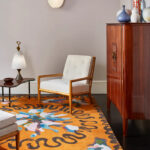
This success reflects a know-how of excellence in the service of haute couture carpets. It is also the result of a human history whose actors could hardly have imagined how far it would take them—becoming one of the most famous carpet houses in the world, now present across three continents: Asia, Europe and North America, with offices in about fifteen countries and nearly a hundred cities worldwide.
It all began in the 1950s in Hong Kong, where the Kadoorie family, entrepreneurs originally from Baghdad in Iraq, had settled after Jewish persecutions in the previous century. In this British-flag city undergoing rapid development, they created a thriving hotel chain. Open to the South China Sea and located on the eastern bank of the Pearl River, the city soon welcomed refugees arriving in large numbers from nearby communist China.
A businessman through and through, Lawrence Kadoorie nevertheless did not forget his memory. He remembered the long journey of his family migrating from country to country, from India to China. Chinese refugees were in need of work. The Chinese tapestry and carpet-making craft urgently needed artisans, or it risked disappearing. What if a workshop were set up in the heart of Hong Kong… And so, in 1956, the first page of Tai Ping was written. At the time it was a small traditional company whose logo has never changed: a tent exposed to storms and wind. Symbolically, it reflects the Kadoorie philosophy that nothing is ever acquired, everything must always be built, and nothing is achieved without solidarity or emotion. It also expresses pride in well-done work, which withstands time and faces external obstacles and weather conditions, as explained at Tai Ping Carpets.
More prosaically, it refers to an anecdote passed down among the manufactory’s employees from generation to generation. In the 1950s, one of the many American architects working in the development of Hong Kong discovered Tai Ping and ordered a huge carpet of nearly 1,000 square metres for the Los Angeles Opera. Too large to be produced in the cramped workshops of the time, the teams built a tent outside. But on the eve of delivery, with the rainy season underway, a typhoon threatened. The tent was raised higher, and the workers, though frightened by the imminent danger of disaster, stayed up all night holding the tent pegs.
Then came the time of modernisation. The ancestral tufting technique, which consists of inserting wool strand by strand into the weave with a needle, is a long and rather tedious process. There was a risk that the women working in hand-knotting would be drawn to more modern jobs in Hong Kong society. The Kadoorie family and their British partners therefore sought a way to optimise and facilitate production. In 1970 came the breakthrough of a Shanghai engineer, also an émigré in the bustling city, Anthony Yeh. That breakthrough was a revolutionary technique that allowed hand-knotting to continue while improving production: the invention of the tufting gun.
Like the wheel, the mechanical tufting gun is a revolution in the world of handmade carpets. Lawrence Kadoorie was concerned: there would now be an obstacle between hand and work. Anthony Yeh, who led the workshops for more than twenty years, agreed—and reassured him: “To hold a hammer and a jack, is Rodin any less of an artist?”
And indeed, it is artists who are at work. They have expert hands but also genuine artistic sensitivity, an infallible reading of the design and a light in their eyes. This is essential, if only to reproduce a rose. Without it, they would give the French flower rounder leaves, closer to the peony, which is their favourite flower.
They are just as much artists as the designers who create for the manufactory: Philippe Starck, Patrick Jouin, Christian Ghion, Patricia Urquiola, Maurizio Galante and Tal Lancman, André Fu, Ramy Fischler, Arik Levy and Sam Baron. And also Stéphanie Coutas, Elliott Barnes, Yabu Pushelberg, Gilles & Boissier or Elena Salmistraro…
Not forgetting the very first, none other than Kenzo Takada. The irony of life and the magic of place: it is in the former flagship Kenzo store on Place des Victoires that Tai Ping has, for several years, been unfolding its new Parisian chapter.
For the Love of Carpets, Tai Ping Carpets Saves Cogolin
The history of the Tai Ping Carpets manufactory is such that it could not remain indifferent to the difficulties faced, in the early 2000s, by the Cogolin manufactory in the town of the same name in the Var department in France, in the Gulf of Saint-Tropez.
It too owes its creation in 1924 to the presence of a large Armenian community, this time having fled Turkey (and also to the local sericulture industry, with silkworm farming in the region). It was purchased in 1928 by the textile engineer Jean Lauer, who, together with his wife Irma Lauer, modified the Jacquard handlooms. Originally intended for weaving fabrics, they were then used to produce carpets. It was the height of the Art Deco boom…
In 2010, Catherine Vergez was the general manager of the Chinese brand in Europe and the Middle East. There was no question for her of watching it close down without doing anything. Especially since taking action could turn Tai Ping Carpets into an empire… She managed to convince her superiors. Even though creating and producing a carpet in the 21st century means praising slowness…
The history of Cogolin is her strongest argument. The golden years of the Var-based manufactory could not simply disappear. Nor could the signatures of the greatest decorators and artists from the pre-war and immediate post-war periods, such as Christian Bérard, Jules Leleu, Fernand Léger and Sonia Delaunay. Or David Hicks and Jean Cocteau.
In the 1960s, more than sixty employees were weaving hand-knotted carpets on 18th-century Jacquard looms. They feared the arrival of the mistral wind, which would disrupt the mechanics of the looms… By 2010, they were barely more than a dozen…
Then came to lead the Cogolin manufactory Sarah Henry, arguably one of the most French of Americans. A lover of design, heritage and craftsmanship excellence, she skilfully combines artistic instinct with marketing sense and has steadily brought the Cogolin manufactory back into the ranks of the major creative houses.
After reviving the Nil carpet designed by the Paris-based Oud studio for the exhibition Les Nouveaux ensembliers at the Mobilier national in Paris in autumn 2025, Cogolin revisits the universe of Christian Bérard, one of the key designers of the Var manufactory, a painter, illustrator, set designer and decorator all at once. By adding two new pieces to its Idylle collection, inspired by Bérard’s gouaches, including a hand-knotted carpet aptly named Éloge.
Tai Ping and designer Sam Baron
For the renowned Tai Ping house, there is no doubt that from a carpet can emerge a dream, and with designer Sam Baron, even dreamlike waves seem to rise endlessly. In the past, the designer had already made carpets take flight. This was back when the Chinese house was based in the former Customs House on rue Montalembert in Paris’s 7th arrondissement.
Sam Baron, then head of the design department at Fabrica, Benetton’s “Villa Medici”, had given carte blanche to eight young talents in residence at the Benetton Group’s research centre in Treviso, Italy. Each of them was tasked with transforming the classic carpet according to their own imagination, to create “From the Floor Up”. An installation – almost a landscape – full of poetry, where the carpet becomes an object transformed into drops of water, waterfalls, optical illusions, tree trunks and curtains of ivy. Pure enchantment.
Today, that enchantment continues to unfold. At the Milan Salone del Mobile in 2022, the Florae Folium concept was born, with three carpets and more than one hundred colours. A major mode inspired by the decorative arts and floral motifs, Sam Baron’s signature theme.
Then, at the dawn of 2026, he presents Florae Folium Series, ten pieces in round, square or rectangular formats, unfolding petals, veins, leaves, branches and pistils. Here, tufting takes centre stage as usual, but this time combined with a top-stitching technique applied to certain parts of the design. The effect is striking. The excellence of the manufactory’s craftsmanship elevates the designer’s watercolor drawings.notted carpet aptly named Éloge.
Episode 8
STUNNING CARPETS, CONTEMPORARY TEXTURES AND INNOVATION
As you will have understood, the carpet is no longer a dust trap or a “grandmother’s activity”. On the contrary, it has taken part in every avant-garde movement right up to today. Take the Vortex carpet, created in 2014 by designers Vincent Breed and Jean Piton at the Moroges manufactory (see Episode 4/2). The former is a glass artisan and the latter a light artist. Together, they created a carpet made of light and glass. A true feat.
Other astonishing carpets include the light “flying carpets” of the Louvre Abu Dhabi, the “Anthropocene” carpet by architect Philippe Rahm, and the sensory carpets of Felipe Ribon. An engineer trained at the prestigious École des Mines and a graduate of the École nationale supérieure de création industrielle (ENSCI), he became interested in the phenomenon of consciousness, already used in medical and creative fields, notably by the Surrealists.
He explains: hypnosis has never been explored in the field of industrial design. So I worked for months to integrate a hypnotic function into existing household objects and to accompany hypnosis, this ordinary state that the brain naturally triggers every 1 hour and 45 minutes.
Although he designed these sensory carpets more than ten years ago, this Colombian-born designer continues to build links between innovation and dream, creating objects that act as mediums through which he questions the function of design and its role in shaping human well-being.
The Vortex Carpet by Vincent Breed and Jean Piton, glass artisan and light artist
Created at the Moroges manufactory, this is a hand-tufted carpet made from New Zealand wool and hand-cut, with engraved glass lens inserts and illuminated by woven optical fibre.
The integration of backlit glass elements into a carpet is a genuine innovation. A first of its kind. Here, the glass serves a dual purpose: it diffuses light and protects the optical fibre. The woven optical fibre is placed beneath the carpet, creating a micro-perforated fabric that becomes a light source.
In this system, the optical fibre, connected to a light source, gives rise to luminous textiles through a patented process. The “back light” illumination of the glass blocks is achieved through luminous fabrics with integrated side lighting within the carpet.
Then, at the dawn of 2026, he presents Florae Folium Series, ten pieces in round, square or rectangular formats, unfolding petals, veins, leaves, branches and pistils. Here, tufting takes centre stage as usual, but this time combined with a top-stitching technique applied to certain parts of the design. The effect is striking. The excellence of the manufactory’s craftsmanship elevates the designer’s watercolor drawings.notted carpet aptly named Éloge.
The light “flying carpets” of the Louvre Abu Dhabi
Created at the Moroges manufactory, this is a hand-tufted carpet made from New Zealand wool and hand-cut, with engraved glass lens inserts and illuminated by woven optical fibre.
Flying carpets straight out of One Thousand and One Nights? Almost.
To illuminate the museum, Jean Nouvel called on 8’18’’, a design and light-arts agency. For the interior lighting of the dome, for the “virtual windows” of the public spaces, and also for the flying carpets of light in the museum galleries, made with luminescent glass. These luminous flying carpets are identical and yet different from one gallery to another. Yes, you read that right: flying carpets of light.
Rémy Cimadevilla from the 8’18’’ agency explains: “Neutral white fluorescent wall-grazing lighting is installed around the perimeter, then a warm white LED accent lighting is integrated into the weave of the light carpet. Finally, the ceiling lighting is done in two ways in cool white: a general indirect lighting and a direct lighting. It makes it possible to reveal the texture of the different glasses chosen by the architect.”
This achievement gives the museum what Jean Nouvel describes as “a horizontal stained glass window.”
The Low-effusivity Carpet by architect Philippe Rahm
When design and carpets become a climate issue
With this carpet, the Swiss architect introduces a completely new style into the decorative arts: the Anthropocene. A style that brings “old decoration” back into the spotlight, when the decorative arts were not only decorative, before fossil fuels, before the 20th century.
He explains this in a book published by HEAD Publishing. He has developed a carpet with the lowest possible thermal effusivity. But what does that mean? Let us listen to him: “A carpet serves to keep your feet warm, a tapestry to insulate walls, mirrors to reflect light.”
For him, “it is CO2 that now determines what is beautiful.”
Thus, his mirror reflects the radiant heat emitted by the human body, and his carpet does not “take” its heat—in fact, it does the opposite.
He further explains: “When we sit on the floor or place our feet on it, the body is in direct contact with a cold stone or concrete floor. By placing a material with low effusivity between the body and the floor, heat transfer is slowed down. The carpet then exchanges heat with both the floor and the body at a very slow rate, protecting the body from cooling through conduction. The carpet thus functions as a barrier against the coldness of the ground.”
If you want to know more, dive into Philippe Rahm’s book Le Style anthropocène, published in 2023 by HEAD – Haute École d’Art et de Design in Geneva.
TO BE CONTINUED
Next report: Kvadrat workshops
Episode 4/4: Silence, weaving at the Kvadrat studio
No Comments