



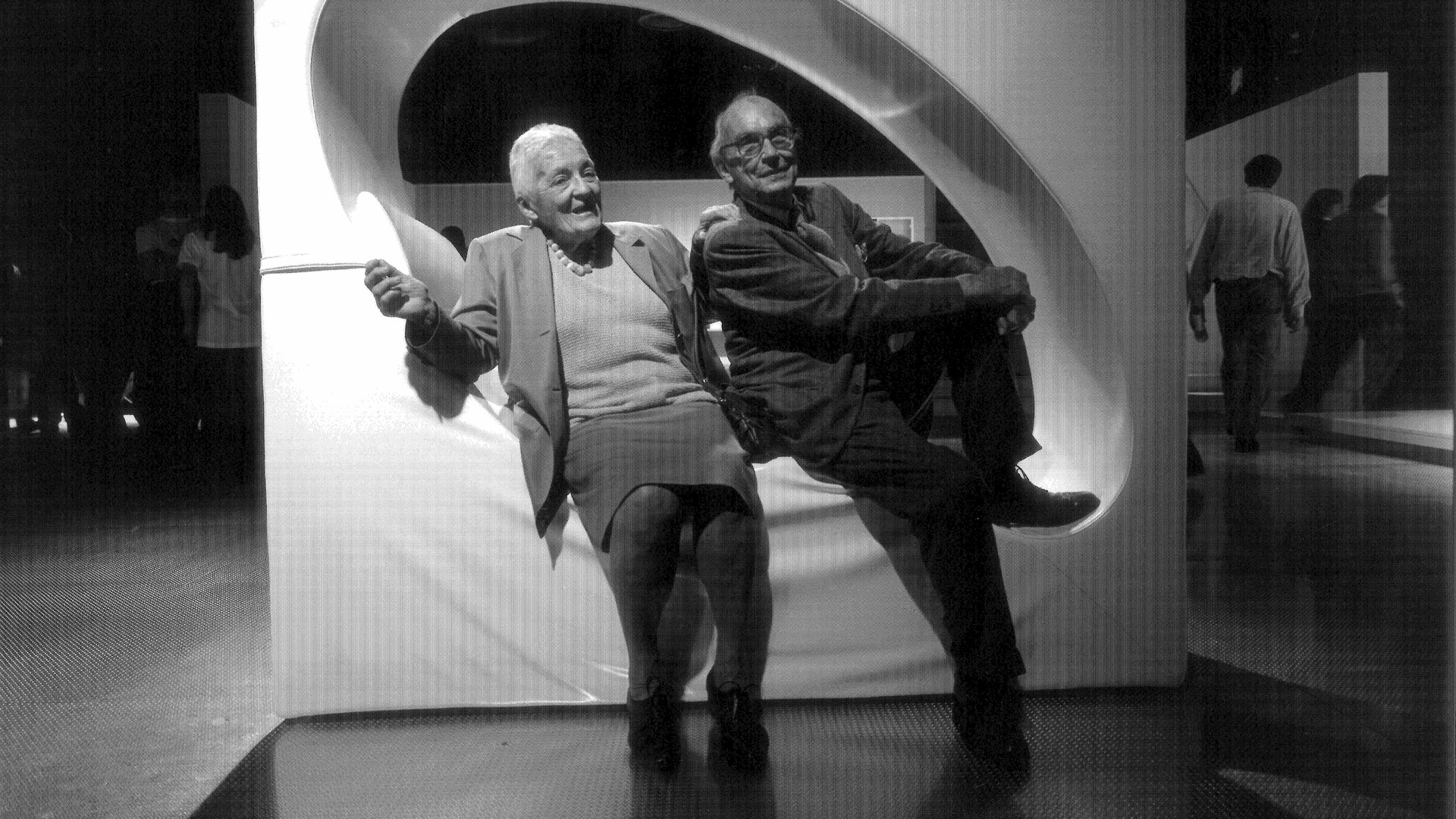
31 Mar Anna and Giulio Castelli – The Kartell House
BRAND SAGAS
KARTELL
Of all the materials, plastic is my favorite! The incredible adventure of a couple who introduced plastic into our homes.
Kartell is a family, a material, and designers. This family is first and foremost a woman and a man. United in 1943 by marriage, they would be even more so by their passion for design and modernity. The material is plastic. As for the designers, as we shall see, there are many. Both those from the beginning who started the adventure and tested plastic in all its possible uses, and those who made Kartell the company it is today, starting with Philippe Starck.
A couple looking to the future
The woman is Anna Ferrieri, one of the first women to graduate in architecture from the Milan Polytechnic in 1943. Rather literary, she evolved, thanks to her journalist father, in a circle of writers where salons were held with James Joyce, Thomas Mann, and Luigi Pirandello. High society!
He, Giulio Castelli, is a chemical engineer. As soon as he graduated, he wanted to explore the potential of plastic with the idea of introducing it into the habitat and then into the home. It must be said that he was admirably trained by the scientist Giulio Natta, who would win the Nobel Prize in Chemistry in 1963 for his work on polymers. It’s in the air. Europe is rebuilding. Plastic could well be this new material that would revolutionize the objects around us.
In 1949, they founded Kartell. It was Anna who imagined the name and designed the brand’s logo. The first object manufactured in 1949 by the young entrepreneur was not a piece of furniture, but a ski rack composed of a set of elastic straps. This system would later be patented by the Pirelli company. Then came the famous household objects and utensils (bucket, basin, dish drainer…). In 1958, the Castellis launched the in-house laboratory, Labware. The new material was tested there from every angle.
When the Castellis’ research bears its first fruit
From this research, a first chair was born in 1964, the 4999 by Marco Zanuso and Richard Sapper. Designed for children, it was above all the first plastic chair in the world and would earn the brand its first Compasso d’Oro. In 1967, the Universale 4867 chair by designer Joe Colombo was created. It was the very first model in the world to be injection-molded.
Then came a series of stackable chairs created by Mrs. Castelli herself, who released a new type of furniture two years later: the Componibili. These funny modular cylindrical storage elements are today design icons, huge bestsellers found all over the world. In barely two decades, the Castellis would change the entire domestic life of Italians and then Europeans. Because all these plastic objects are beautiful, not too expensive, and colorful!
Restoring plastic’s letters of nobility
By the end of the 1980s, the revolutionary material was no longer what it used to be. It languished under a dated appearance. The savior arrived in 1988. It was Claudio Luti. Former right-hand man to fashion designer Gianni Versace and husband to the daughter of Kartell’s founding couple, he took over the brand and became its president. There was a lot of work to do and an image to restore. Luti bet everything on research and innovation, and gambled on collaborations with international designers and architects: Ron Arad, Antonio Citterio, Ferruccio Laviani, Piero Lissoni, Enzo Mari, Alberto Meda, Vico Magistretti, Tokujin Yoshioka, Patricia Urquiola… Not forgetting Philippe Starck.
The era of transparent plastic
In 1999, Kartell developed the world’s first polycarbonate chair. Completely transparent plastic. It was designed by Philippe Starck, a great defender of democratic design. It would be the Marie. Then, Claudio Luti and Philippe Starck pushed the technical prowess further to create an armchair. The Louis Ghost, a planetary success with 1 million copies sold worldwide! It took the firm more than fifteen years of research to perfect this famous transparency. And it would take several more long years of R&D to go from the 3-kilo weight of the Marie chair to the 30 kilos of Starck’s Uncle Jack sofa, the world’s largest example of injection-molded transparent polycarbonate.
After transparency, the plant-based
Today, plastic no longer has a good reputation. Is this a fatal blow for the Castelli heirs? Not at all; Giulio Castelli’s son-in-law would like to continue to fulfill his father-in-law’s wishes by developing, with the materials of his time, “production technologies aimed at saving material and process efficiency”. This was achieved in 2016, with the Organic Chair designed by architect Antonio Citterio, using an innovative and sustainable plant-based material.
The commitment of the 3rd generation
The family’s goal, led by Lorenza and Federico Luti, lies between creation, technology, and respect for the commitment defined in the “Kartell loves the planet” manifesto. “The arsenal of the future,” according to Claudio Luti. And isn’t that also what design is: improving everyday life?
On the dawn of its 80th anniversary, Kartell seems to be taking this path and has managed to maintain a fine technological lead. The firm is resolutely committing to sustainability. Flagship materials such as recycled plastic, polypropylene, ABS, and PMMA are obtained from pure industrial waste. The wood comes from certified forests. Biological materials result from a process using agricultural waste. Polycarbonate 2.0 generates green transparency from paper and cellulose waste. Ceramics and fabrics are made with recycled materials down to organic finishes without chemical solvents.
No Comments