



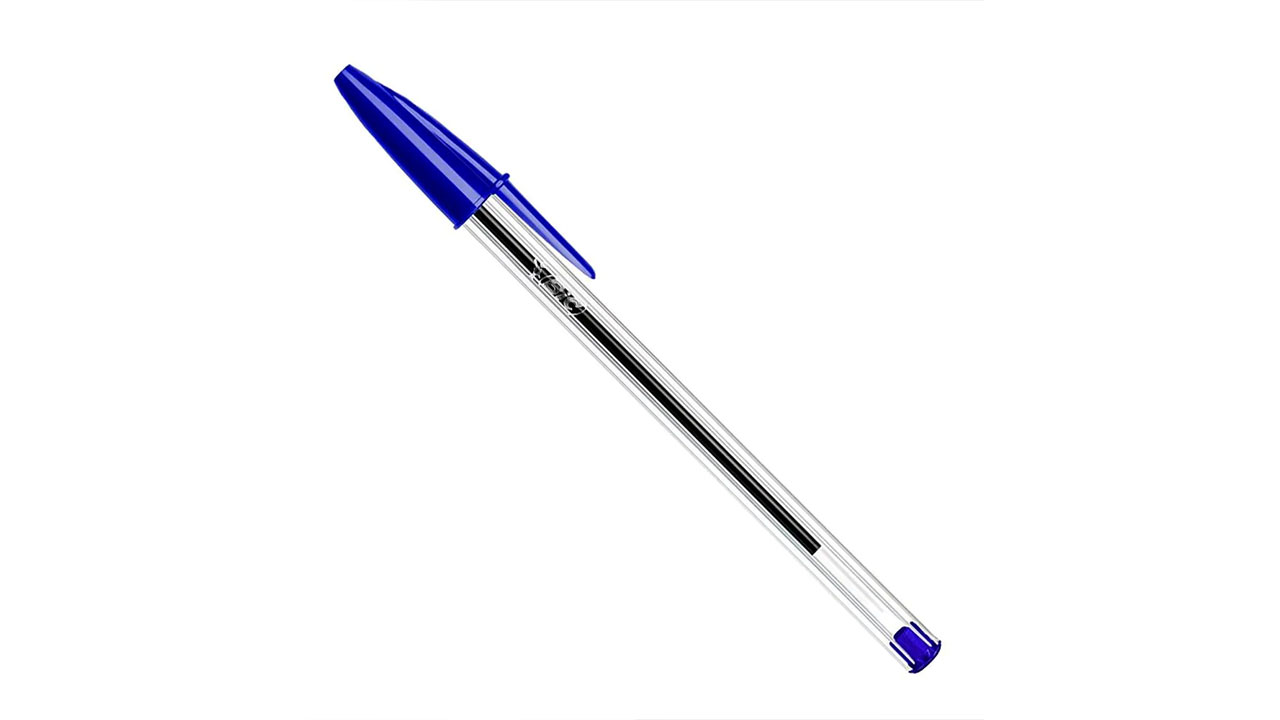
19 Feb THE BIC CRISTAL
THE SHORT HISTORY OF AN OBJECT
THE BIC
On September 3, 1965, the National Education system was in mourning. A grand lady, over a century old, had just passed away.
The Sergent Major nib is no more. After having “dragged his feet” for a long time, the minister of the time was finally going to authorize 11 million school kids—raised until then in the cult of thick and thin strokes, Pelikan violet ink, porcelain inkwells, blotting paper, and the nasty inkblots that cost them good marks—to abandon the historic tool of knowledge: the pen nib… in favor of a polystyrene tube named the ballpoint pen, more familiarly called the BIC.
It’s an understatement to say that circular 65-338 forever changed the life of the French student.
Suddenly, they were in possession of a two-in-one object: a tool they didn’t need to dip back into ink every five words, and a blowpipe allowing them to bombard their little classmates with chewed-up paper spitballs.
Baron BICH, the head of the firm, had won his battle.
Since 1960, indeed, with the help of the famous advertiser (at the time, we called them poster artists) Raymond Savignac, wasn’t it already a little schoolboy with a ball-shaped head who promoted the brand, replacing the slogan “it runs, it runs, the Bic point”… A schoolboy, yes, because they were the ones who would make up at least 40% of the sales of the said Bic…
But how about we talk a little about the history of this revolution that then exploded in the writing world.
Let’s go back to just before the war. In Paris in 1938, two Hungarians, the BIRO brothers, Laszlo-Joseph, a journalist, and Györgi, a chemist, filed a patent.
They had first observed the extreme drying speed of printing ink, then solved the problems of its viscosity, and finally invented the famous little ball… which gave birth to this object of genius!
But they were still far from the mark: the ball didn’t turn smoothly, the pen leaked, and the ink clumped.
Fleeing the war and anti-Semitic laws, Laszlo emigrated to Argentina in 1940 under the name Lisandro José;
he would be joined by his brother three years later.
A new patent was filed on June 10, 1943, under the name of the company they had just created, Stylo BIRO.
The revolutionary contraption was called the Birome. And it was even adopted in these times of war by the RAF, the Royal Air Force.
It must be said that high up in the sky, the Birome worked wonders.
After the war, Baron Marcel BICH bought the precious patent from the BIRO brothers in 1949.
But who was this baron? An entrepreneur of Italian descent who had been successively a delivery man, a sales representative, and the director of the Stephens Inks company.
The buyout of the Biro brothers’ patent might well have been a breath of fresh air for the man who had just invested 50,000 francs in 1945 with Edouard Buffard in a modest workshop, a company named PPA for Porte-plume, Porte mine et Accessoires (Penholders, Mechanical pencils, and Accessories)… on Impasse des Cailloux in Clichy.
Well, the beginnings were more difficult than expected… It took a good two years for Swiss watchmakers to perfect the sphericity of the ball.
But when everything was ready, it rolled smoothly! And this right before Christmas 1950!
The famous BIC cristal was born. The first disposable, nomadic product.
But it wasn’t quite a victory yet. Because while it was revolutionary, it was also judged to be quite ugly!
And too expensive! It cost 0.50 francs… When a baguette and a postage stamp were 0.15.
So, getting retailers to stock a ballpoint pen at such a price was no piece of cake!
Was the Bic cristal really that ugly? No, not really, but not wildly glamorous either.
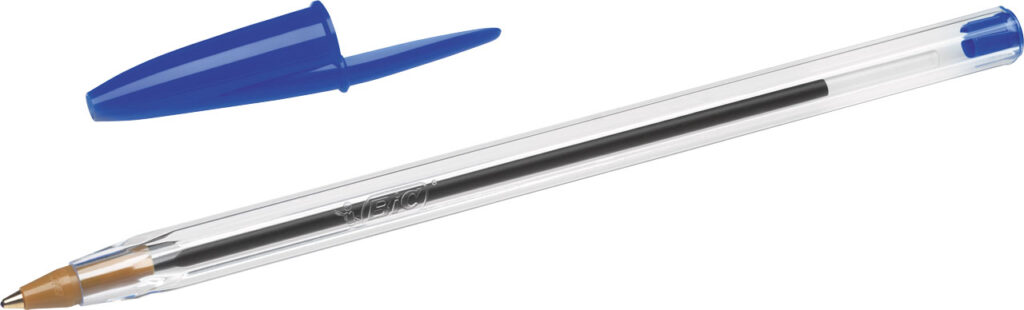
Even if its rigid, hexagonal body, made of transparent polystyrene—that is to say, plastic—allowed you to track the available ink volume… And if you want to know more… well, let’s say that the polypropylene cartridge tube contains 0.4 grams of oil-based ink with a drying time of 2 seconds, and that the famous ball, which doesn’t stick or smudge in the least, was made of stainless steel and later tungsten carbide.

© Bic
© Bic
© Bic
As for the clip cap, it brought joy to storekeepers… Now, only your butcher would keep a pencil tucked behind his ear.
And all this weighed only 5.80 grams, measured just 14.3 cm, and provided 2 km of writing with a lifespan of 3 years…
So, okay, it’s not exactly glamorous and it’s expensive… but since it seems super effective, sturdy, and doesn’t smudge, you’ll go to the dry cleaner less often anyway… So, all things considered!!
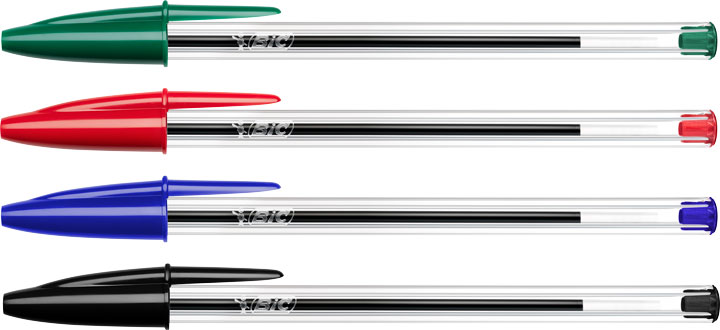
Very quickly, the Bic took on colors, initially four: black, blue, red, and green, and expanded its range over the years to up to 11 colors…
Today, the Bic has been writing for a quarter of a century… Do you know many products that, in nearly 3/4 of a century, haven’t changed their look?
That is the case with the Bic cristal.
Ah, but that’s not quite right… Because, in 1991, a small hole was added to the cap to prevent children who might have accidentally swallowed it from suffocating.
We don’t know if that ever actually happened!
Finally, if you want to shine in society, impress your mother-in-law playing Trivial Pursuit, or win on Who Wants to Be a Millionaire or whatever else… Know that the French have bought 100 million of them and the world 100 billion!
Umberto Eco’s Tribute
Know also that, speaking more literarily, the great Italian writer Umberto Eco spoke of the Bic in these words: “Born intentionally ugly and became beautiful because it is practical, economical, industrialized, and organic, it is the only example of socialism that has canceled the right to property and all social distinction.”
ARTISTS AND BIC
When people think of Bic, they naturally think of school. Few, however, associate the brand with artists. Yet ever since its creation, countless artists have used the Bic ballpoint pen as part of their creative practice. The French writing instruments company has long supported artistic creation, especially when its iconic pen serves as a source of inspiration.
For nearly thirty years, Bic has welcomed artists into its creative community. Today, its collection includes around 250 works by both established and emerging artists. The collection is permanently displayed at the company’s headquarters in Clichy, near Paris.
In 2026, Bic is opening a new chapter by launching a virtual museum dedicated to its contemporary art collection. As a result, part of this collection will be accessible to everyone, anywhere in the world.
According to Alix Dufour, from Bic’s Art & Creativity department, “This museum is a new platform for expression for the artists of the BIC community.” It is a wonderful way to share with a wider audience the unexpected creative possibilities offered by the everyday objects that surround us.



Go on! Show off with your Bic!
No Comments