



31 Mar THE COCOTTE
BRAND SAGAS
LE CREUSET
THE COCOTTE
A symbol of French culinary art, the famous enameled cast iron cocotte was born in 1925 in the Aisne. The story of a volcanic orange icon.
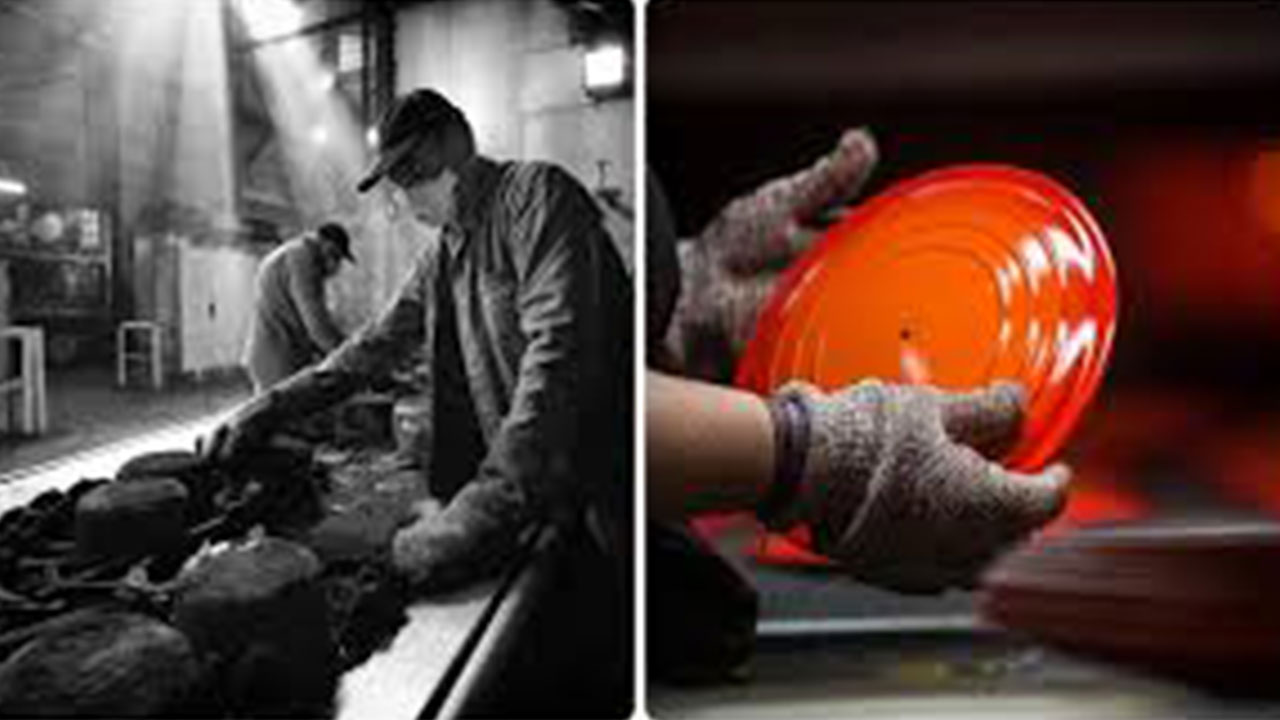
For thirty years, on the last weekend of November, people have been rushing onto all the roads of the Aisne department, and particularly around Fresnoy-le-Grand. A large industrial Picardy town in the Vermandois, located about fifty kilometers from the Belgian border. But what exactly is going on here? What is the event that attracts thousands of visitors from the Paris region, but also from abroad, particularly from the United States and even Hong Kong?
The answer: the clearance sale of the Le Creuset company, which indeed makes a very large part of its cast iron cocotte sales abroad—more than 92% in 2020. And undoubtedly even more since food Instagrammers have been full of praise for these cocottes and would not cook their recipes in any other utensils for anything in the world. “It’s an event that fascinates the staff,” says one of them. “It’s still the symbol of French culinary art,” says another.
The Belgian alliance in Picardy
The company, however, was founded by two Belgian industrialists, who settled in this small French village in 1924. The choice of location was, of course, no coincidence. The village is located at the crossroads of the transport routes for the raw materials—coal, iron, and sand—necessary for the activity they wanted to develop. Armand De Saegher, a specialist in cast iron molding, and Octave Aubecq, an enameler, would indeed create a foundry the following year to enamel kitchen utensils. Freeing women while dishes simmered on their own—now that was an idea that would catch on!
The first utensil to leave the factory in 1926 was a round enameled cast iron cocotte in “volcanic orange.” To do this, they used new enameling techniques to imitate the intense orange hue of molten cast iron obtained in a refractory material pot, called a crucible (“creuset” in French). The company’s name was found!
Design and modernity
This first orange cocotte would become an icon. Those that followed were not left behind. In 1955, from the color orange, they already moved to golden yellow. But this was just a beginning. Then came great names in design, who made shapes and colors explode. Starting with Raymond Loewy, the father of industrial design, to whom we owe the Shell logo or the interior of the Concorde.
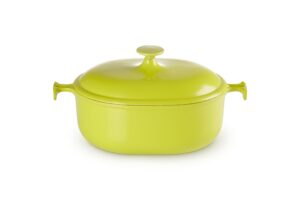
As a speed enthusiast, he chose to give his 1958 Le Creuset pot, named La Coquelle, a futuristic, curved, streamlined, and aerodynamic shape. He who advocated the idea that “ugliness sells poorly” was thrilled: his anise-green cocotte with round handles caused a sensation. After Raymond Loewy, it was the turn of the Italian designer Enzo Mari (with his round Mama in 1972) and the French Jean-Louis Barrault (Futura range in 1987) to look into the cocotte.
Centuries-old craftsmanship
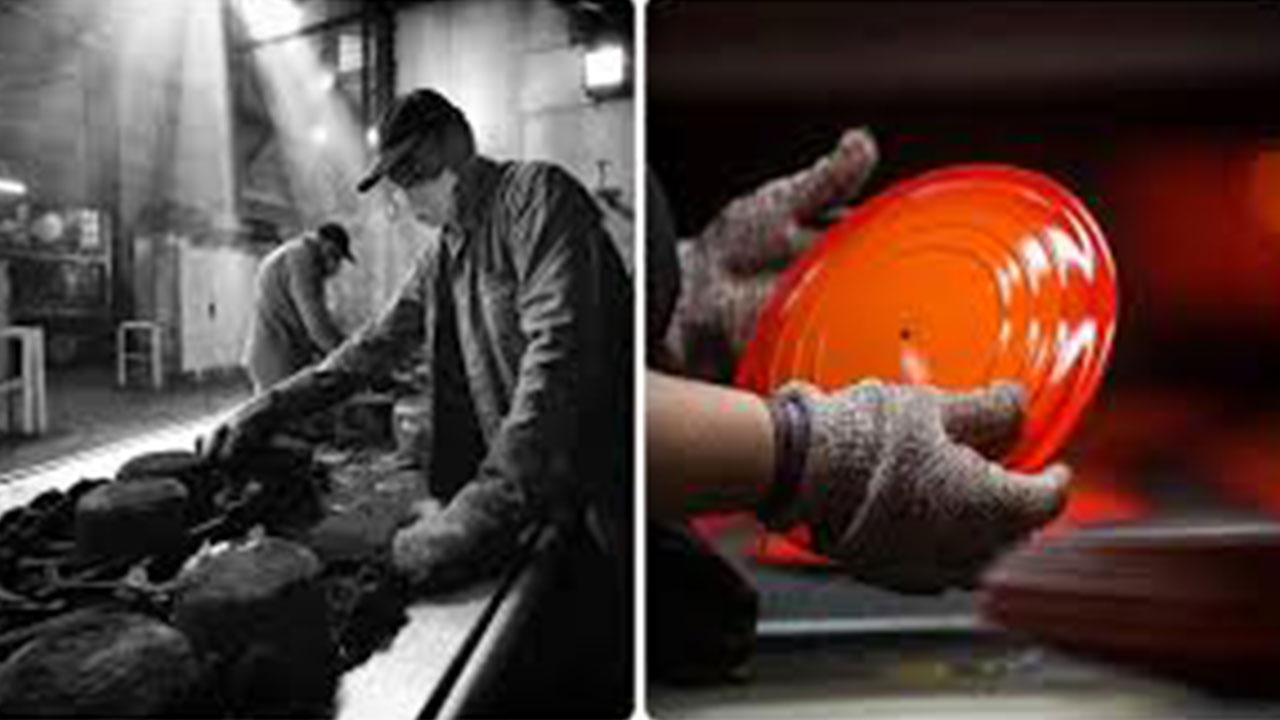
Only quality is non-negotiable. The cast iron bestseller is still manufactured in Fresnoy-le-Grand, according to an almost centuries-old process. In the new 28,000 square meter factory, built in 2013 on its historic site, the iron and carbon alloy is still first heated to 1,400 degrees before being placed between two sand molds adjusted to the millimeter. Upon coming out, each piece is trimmed, ground, retouched, and then covered with a thin layer of enamel.
From one end of the chain to the other, making a cocotte takes a good four hours and is subject to around thirty quality controls. Here, the watchword is clear: “At the slightest imperfection, into the trash.” The smallest Le Creuset cocotte doesn’t weigh its 4 kilos for nothing!
Jean-Louis Barrault
No, this is not the theatre actor referred to here, but a relatively little-known French designer, born in 1938 in Bourges. Today, at 87 years old, he can be found on Linkedin.com, where he speaks about himself in these terms:
“Nearly 50 years in the world of design, ‘on-the-job’ training thanks to my first client who, at 25, gave me the opportunity of a lifetime, because at that time, in 1963, the word ‘design’ did not exist in France, people spoke of aesthetics, of styling… Moulinex at that time allowed me a complete apprenticeship in industry and in the trades in which this company would become very skilled in plastics and become a world leader in small household appliances. The more Moulinex grew, the more I had to develop my staff to meet its demand and master all the areas of design: product, graphic, packaging, point-of-sale materials (PLV), stand.”
His Futura cocotte for Le Creuset is exhibited, along with some of his creations, at the Musée de Saint-Quentin-en-Yvelines in the Paris region. Other works of his can also be found at the Musée des Arts Décoratifs in Paris and at the Museum of Modern and Contemporary Art (MAMC+) in Saint-Étienne.
Enzo Mari
This designer from the golden age of Italian design, who died in 2020 at the age of 88, said that “good design” should be “durable, accessible, functional, well made, emotionally meaningful, resistant, socially useful, beautiful, ergonomic, and economically accessible.” Quite a statement!
Sorry, the comment form is closed at this time.