



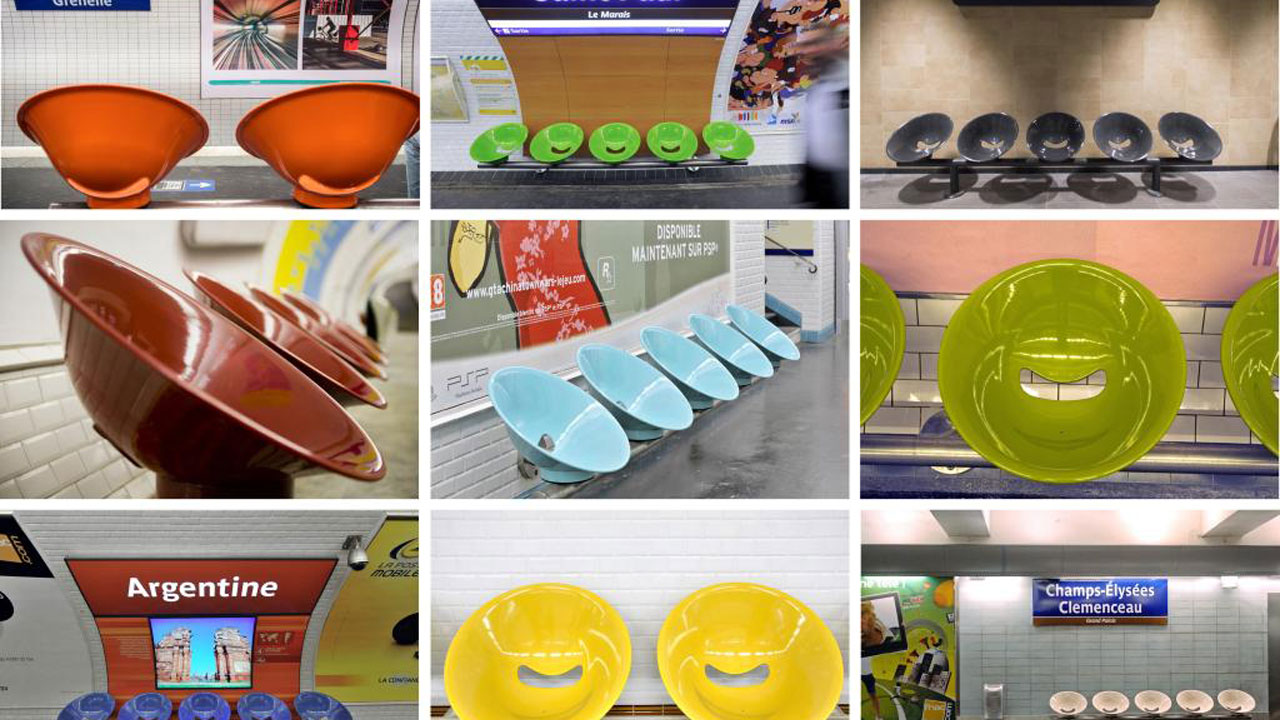
31 Mar The Paris Metro seats
DESIGN IN THE CITIES
THE PARIS METRO
SEATS
Since 1973, the famous enameled sheet metal shell seats have punctuated Parisian stations. A true aesthetic and societal revolution signed by Paul Andreu and Joseph-André Motte. [cite: 3, 9]
Every Parisian and every tourist visiting the French capital has sat at least once in these famous colorful shell seats[cite: 3]. Designed from 1973 by architect Paul Andreu and designer Joseph-André Motte, they replaced the wooden benches that no longer met fire safety standards[cite: 3].
The Andreu-Motte Style
Between 1974 and 1984, around a hundred stations of the metropolitan network were decorated in this innovative style[cite: 6]. Bright colors, contrasting with the white background of the stations, were applied to benches, lighting strips, and seats, thus helping users navigate more easily[cite: 6]. Originally, three colors dominated: Motte blue, Kepler yellow, and Andreu-Motte orange, later joined by green[cite: 7]. Later, specific touches appeared: pink for the Concorde station (line 1), and purple for Concorde (line 8), Palais-Royal-Musée du Louvre (line 1), and Opéra (line 3)[cite: 8].
The Individual at the Center of Design
These enameled sheet metal shell seats represent the very first example of an individual seat in the metro[cite: 9]. Their shape was conceived to free up space while ensuring maximum comfort, in a resolutely design-oriented approach[cite: 10].
Joseph-André Motte, already famous for designing the interiors of the Orly and Roissy CDG airports [cite: 4, 5], explained this philosophy in the book Question(s) design (2010) by Christine Colin: “Man today is no longer human dust in a shapeless multitude”[cite: 11]. For him, the user is a unique individual who needs a seat all to himself[cite: 12, 13, 14, 15]. “We can no longer make people sit on wooden benches,” he stated[cite: 16].
However, the losers in this evolution were the homeless[cite: 17]. To allow them to continue sleeping in the metro, the cement benches along the entire length of the platform were kept[cite: 17].
The Evolution with Ouï-dire
From 1985, the Ouï-dire architecture agency took over the design of 27 stations[cite: 19]. Continuing the idea of white stations, it introduced individualized seats separated by inverted scythe-shaped armrests, as well as the emblematic “sit-stand” seats[cite: 20].
No Comments